
Qualitätskontrolle bei elektrischen Zahnbürsten:
OEM-QC-Leitfaden 2026
Eine vollständige Übersicht über den Qualitätskontrollprozess für elektrische Zahnbürsten in einer erstklassigen OEM-Fabrik für Mundpflege – einschließlich IQC, IPQC, OQC, Wasserdichtigkeitstests, Borstenstandards und Inspektion vor dem Versand.
Fehlerraten-Benchmarks basierend auf dokumentierten QC-Aufzeichnungen der ISO 13485-zertifizierten Produktionsstätte von Relish Technology (Shenzhen, 2024–2025).
Wichtigste Erkenntnisse
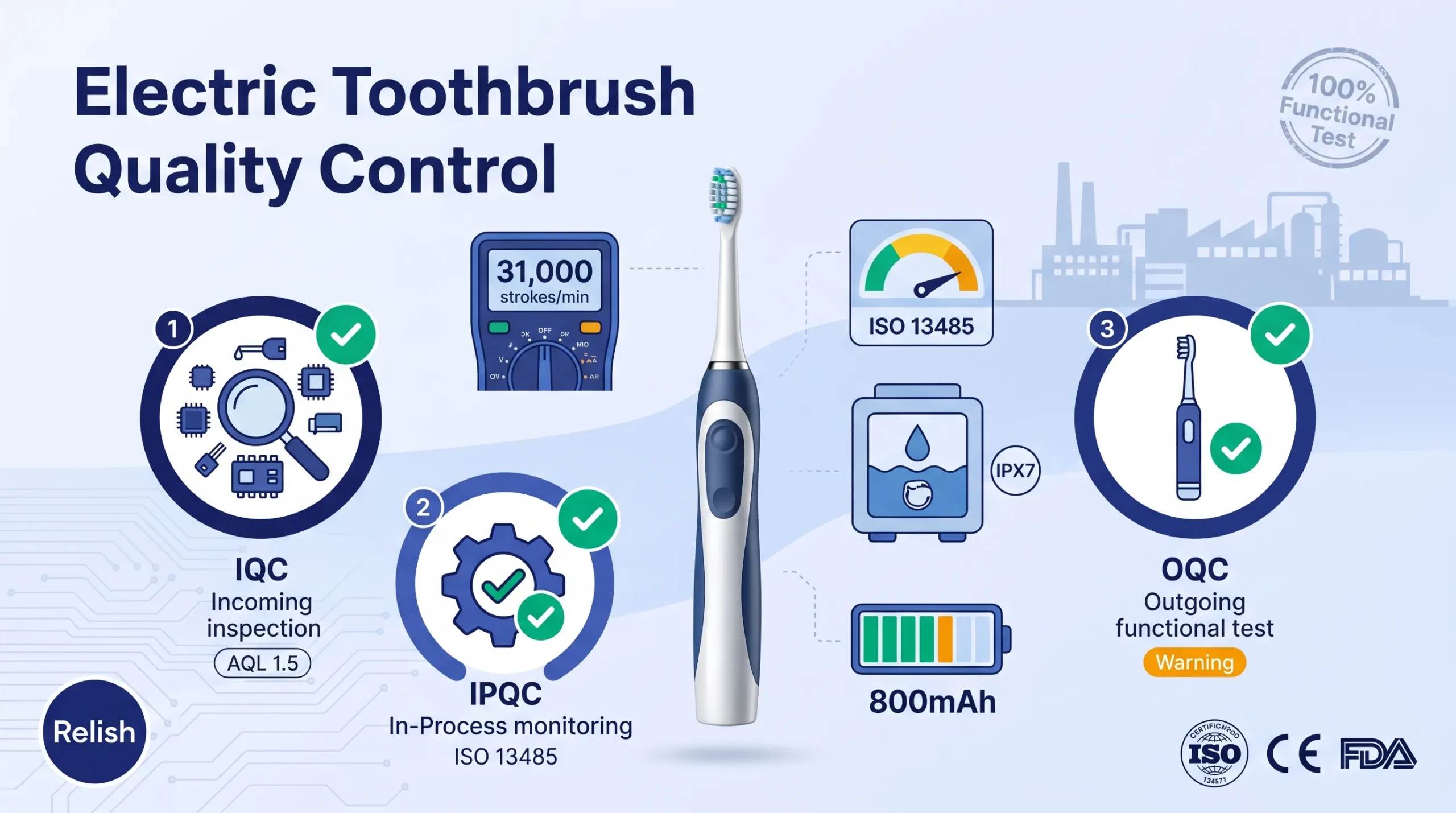
- Top-chinesische Hersteller elektrischer Zahnbürsten erreichen Fehlerraten unter 0,3% durch eine dreistufige Qualitätskontrolle für elektrische Zahnbürsten: IQC → IPQC → OQC
- 100% Funktionstests jedes fertigen Geräts sind nicht verhandelbar – Stichproben allein reichen für Elektronik nicht aus
- Die #1-Ursache für Feldausfälle sind minderwertige Batterien von unqualifizierten Lieferanten – überprüfen Sie stets die UN 38.3-Zertifizierung von benannten Lieferanten (ATL, EVE, BYD, Samsung SDI)
- IPX7-Wasserdichtigkeit erfordert Tauchkammertests im Werk – vergewissern Sie sich, dass diese Ausrüstung vorhanden ist, bevor Sie elektrische Zahnbürsten bestellen
- Die Borstenendabrundung muss überschreiten 90% gemäß ADA-Richtlinie – dies ist ein häufiger Qualitätsfehler in kostengünstigen Fabriken, die elektrische Zahnbürsten herstellen
- Die Inspektion vor dem Versand (SGS/Bureau Veritas) bei Bestellungen über 1.000 Einheiten schützt vor Produktionssubstitution während des Qualitätskontrollprozesses für elektrische Zahnbürsten
Die Qualitätskontrolle bei der Herstellung elektrischer Zahnbürsten ist komplexer, als die meisten Markeninhaber erwarten. Im Gegensatz zu passiven Konsumgütern sind elektrische Zahnbürsten elektronisch-mechanische Geräte, die in feuchten Umgebungen zuverlässig funktionieren müssen – und sie kommen in den Mund von Menschen. Die Folgen von Qualitätsausfällen sind schwerwiegend: kurzfristig Amazon-Rücksendungen und negative Bewertungen, langfristig behördliche Maßnahmen und Reputationsschäden für die Marke.
Das Verständnis des Qualitätskontrollprozesses für elektrische Zahnbürsten ermöglicht es Ihnen, bei der Bewertung von OEM-Lieferanten die richtigen Fragen zu stellen und vertragliche Qualitätsanforderungen festzulegen, die Ihre Marke schützen. Dieser Leitfaden erklärt jede Phase, vom Rohmaterialeingang bis zur Containerbeladung.
Das 3-stufige Qualitätskontroll-Framework für elektrische Zahnbürsten: IQC → IPQC → OQC
Ein vollständiges Qualitätsmanagementsystem für die OEM-Produktion elektrischer Zahnbürsten umfasst drei verschiedene Produktionsstufen:
Stufe 1: Eingangsqualitätskontrolle (IQC) für elektrische Zahnbürsten
IQC ist die erste und wirkungsvollste Stufe der Qualitätskontrolle für elektrische Zahnbürsten. Minderwertige Komponenten, die die IQC passieren, werden zu fehlerhaften Fertigwaren – teuer zu beheben und möglicherweise nicht mehr zurückrufbar, sobald sie versandt wurden.
Kritische Komponenten, die eine 100%-IQC-Prüfung erfordern
| Komponente | Wichtige Tests | Bestehenskriterien | Priorität |
|---|---|---|---|
| Gleichstrommotor (sonisch) | Vibrationsfrequenz (Hz), Drehzahl, Geräuschpegel, Stromaufnahme | 000±500 Hübe/min; <45dB; Strom innerhalb der Spezifikation | Kritisch |
| Lithium-Ionen-Akku | Kapazität (mAh), Spannung, Lebensdauer, Temperatur; UN 38.3 Prüfzertifikat erforderlich | Innerhalb von 5% der Nennkapazität; UN 38.3 Zertifikat erforderlich | Kritisch |
| PCB / Elektronische Steuerung | Durchgangsprüfung, Timer-Funktion, Modusumschaltung | Alle Funktionen gemäß Spezifikation; keine Kaltlötstellen | Kritisch |
| Griffkörper (Spritzguss) | Maßtoleranzen, Oberflächenbeschaffenheit, Farbabgleich | ±0,2mm Toleranzen; Pantone-Farbabgleich | Wesentlich |
| Nylon-Borsten | Diameter (mm), material (food-grade nylon), end-rounding per ADA guidance | Soft: 0.15mm; Medium: 0.2mm; >90% ball-tipped ends | Kritisch |
| IPX Sealing Components | O-ring dimensions, material elasticity, seating geometry | Shore A hardness 60–70; no gaps on assembly jig | Kritisch |
| Charger / Charging Base | Output voltage, current regulation, CE/UL mark | 5V±0.25V; 1A±0.1A; certified marks present | Kritisch |
Stage 2: In-Process Quality Control (IPQC) for Electric Toothbrush Manufacturing
IPQC monitors quality as units are being assembled during the electric toothbrush manufacturing process. Problems caught during IPQC cost far less to fix than those discovered after full assembly. The most advanced factories use Statistical Process Control (SPC) to detect quality drift before defects occur.
IPQC Checkpoints by Production Stage
| Stage | IPQC Check | Method | Frequenz |
|---|---|---|---|
| Motor Installation | Torque spec, mounting alignment, wire routing | Torque wrench, visual | Every 50 units |
| PCB Assembly | Automated optical inspection (AOI), solder joint quality per IEC 60335 safety standards | AOI machine + visual | 100% AOI |
| Battery Installation | Polarity, seating, weld quality | Visual + continuity test | 100% |
| Handle Assembly | Snap-fit torque, gap dimensions, cosmetic appearance | Go/No-Go gauge, visual | Every 100 units |
| Bristle Tufting | Tuft count, anchoring force, end-rounding confirmation per ADA guidance | Pull test, microscope sample | Every 200 heads |
| IPX Seal Assembly | O-ring seating, compressed air leak test per IEC 60529 IP Code | Pressure decay tester | 100% |
| Label/Branding Application | Position, adhesion, legibility, regulatory text accuracy | Visual + go/no-go template | Every 50 units |
Statistical Process Control (SPC)
SPC uses real-time data from production to detect trends before they become defects. Top-tier factories track control charts for critical parameters (motor frequency, IPX seal pressure, battery voltage) and trigger corrective action when readings approach control limits — before any defective unit is made.
Stage 3: Outgoing Quality Control (OQC) — 100% Functional Testing for Electric Toothbrushes
OQC is the final quality gate before products enter packaging. 100% functional testing — not sampling — is the standard for electronics in the electric toothbrush quality control process. Sampling finished units allows defective products to reach customers; 100% testing catches every unit that fails before it ships.
Functional Test Specs
Waterproofing Tests
Appearance Standards
Packaging Verification
Need a Manufacturer with Proven Electric Toothbrush Quality Control?
Relish Technology operates an ISO 13485-certified 20,000㎡ facility with documented defect rates below 0.3%. Request a QC sample order today.
Request QC Sample Order →Defect Classification System for Electric Toothbrush Quality Control
Defects are classified into three levels that determine how they are handled in the electric toothbrush quality control process:
| Class | Definition | Examples | Action | AQL Level |
|---|---|---|---|---|
| Kritisch | Safety risk or regulatory non-compliance | Battery failure, waterproofing breach, electrical shock risk, incorrect voltage | 100% rejection, root cause analysis required | AQL 1.5 (0 tolerance) |
| Wesentlich | Functional failure affecting usability | Motor below spec, missing brushing mode, timer malfunction, bristle shedding | Batch hold, rework or reject | AQL 1,5 |
| Gering | Cosmetic defect not affecting function | Surface scratch (not on grip), minor color variation, packaging crease | Record and release with written approval | AQL 2.5 |
Bristle Quality: The Most Overlooked QC Factor in Electric Toothbrush Manufacturing
Bristle quality is frequently underspecified by brand owners and under-inspected by factories manufacturing electric toothbrushes. Yet bristle quality directly affects dental outcomes and drives some of the most common consumer complaints.
Bristle End-Rounding: The ADA Standard
Die ADA (American Dental Association) requires that at least 90% of bristle ends are properly rounded (ball-tipped) for a toothbrush to receive ADA endorsement. Un-rounded bristle ends are sharp and cause gum abrasion — this is a primary cause of negative reviews and dental professional complaints.
Proper end-rounding requires a separate mechanical ball-tipping process after bristle cutting. Low-cost factories skip this step to reduce per-unit cost. Always request microscope inspection photos of bristle ends as part of your electric toothbrush quality control protocol — this is explicitly required by the ADA endorsement program.
Pre-Shipment Inspection: Your Last Line of Defense
A pre-shipment inspection by an accredited third party (SGS, Bureau Veritas, Intertek) provides an independent quality verification after production is complete (typically when 80–100% of goods are finished and packaged). For orders above 1,000 units, this investment is essential for any electric toothbrush quality control strategy.
What a Pre-Shipment Inspection Should Cover
- Random sample selection from cartons (AQL 2.5 for cosmetic defects)
- Functional testing: vibration frequency, all modes, timer, charging
- Waterproof test (IPX5 minimum for every sample)
- Packaging accuracy: barcode scan, manual language, label accuracy for destination market
- Carton drop test (1.2m onto each face)
- Quantity count against commercial invoice
- Documentation check: CE Declaration, FDA labeling, UN 38.3 for battery transport
Häufig gestellte Fragen
Source from a Factory with <0.3% Defect Rate
Relish Technology's three-stage QC system, ISO 13485 certification, and 15 years of OEM experience deliver the quality your brand depends on. Request a factory audit and sample order today.
Request Samples & QC Report →Referenzen und Quellen
- ISO. (2016). ISO 13485:2016 — Medical devices — Quality management systems. Abgerufen von https://www.iso.org/standard/59752.html
- ANSI/ASQ. (2008). Z1.4-2008: Sampling Procedures for Inspection by Attributes. American Society for Quality. Retrieved from https://webstore.ansi.org/Standards/ASQ/ANSIZ12008
- IEC. (2020). IEC 60335-2-52: Safety — Oral hygiene appliances. International Electrotechnical Commission. Retrieved from https://www.iec.ch/
- ADA (American Dental Association). (2023). Toothbrush Endorsement Program Technical Requirements. ADA.org. Abgerufen von https://www.ada.org/
- IEC. (2021). IEC 60529: Degrees of protection provided by enclosures (IP Code). International Electrotechnical Commission. Retrieved from https://www.iec.ch/basecamp/pyramid/