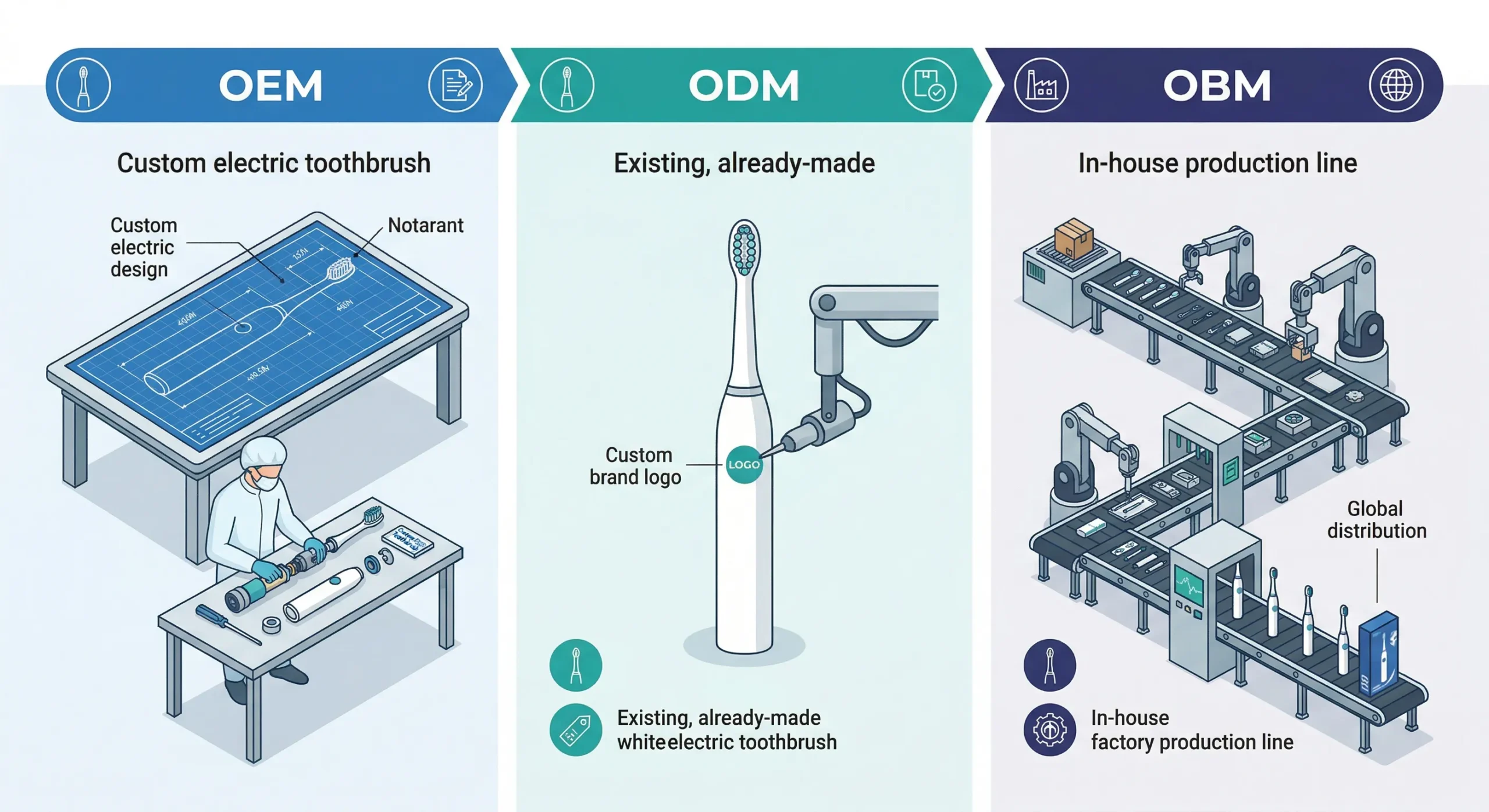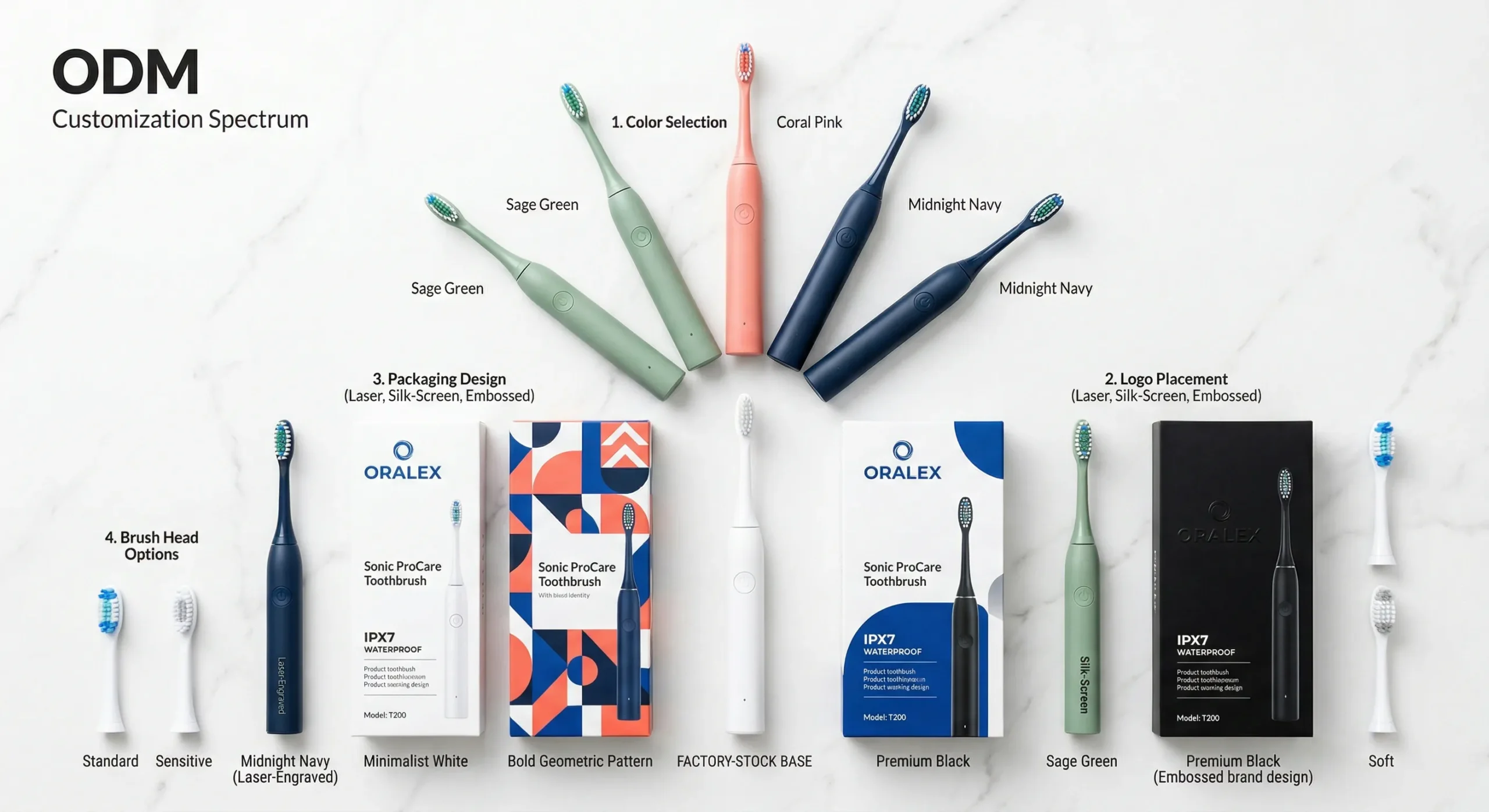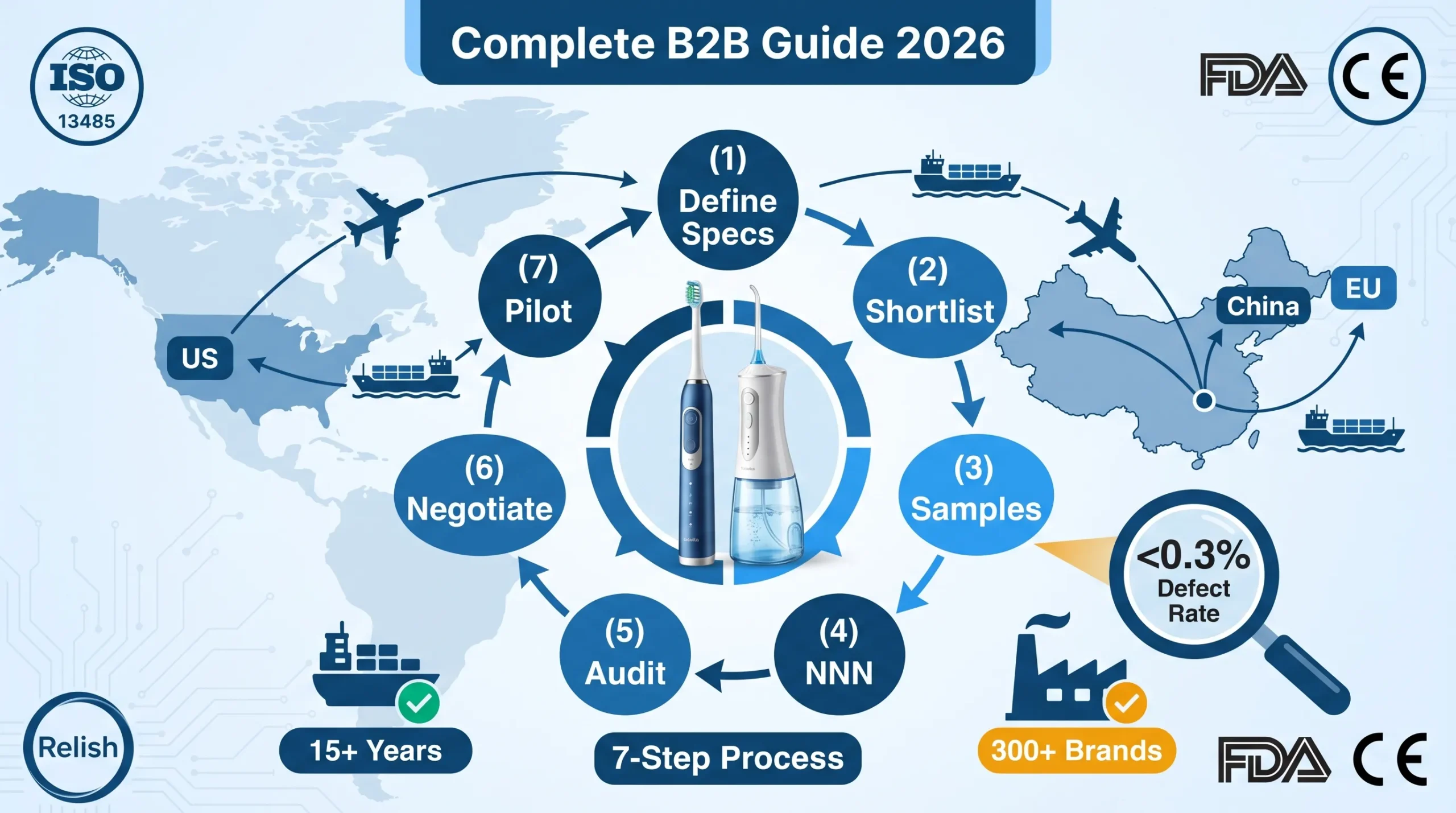

Van magnetische spoelaandrijvingen en DC-motoren tot AI-gestuurde poetsanalyse — een diepgaande blik van een fabrikant op de techniek, fysica en productie achter moderne elektrische tandenborstels.
* Vergeleken met het gebruik van een handtandenborstel. Klinische studies hebben aangetoond dat sonische tandenborstels significant meer plaque verwijderen dan handmatig poetsen.
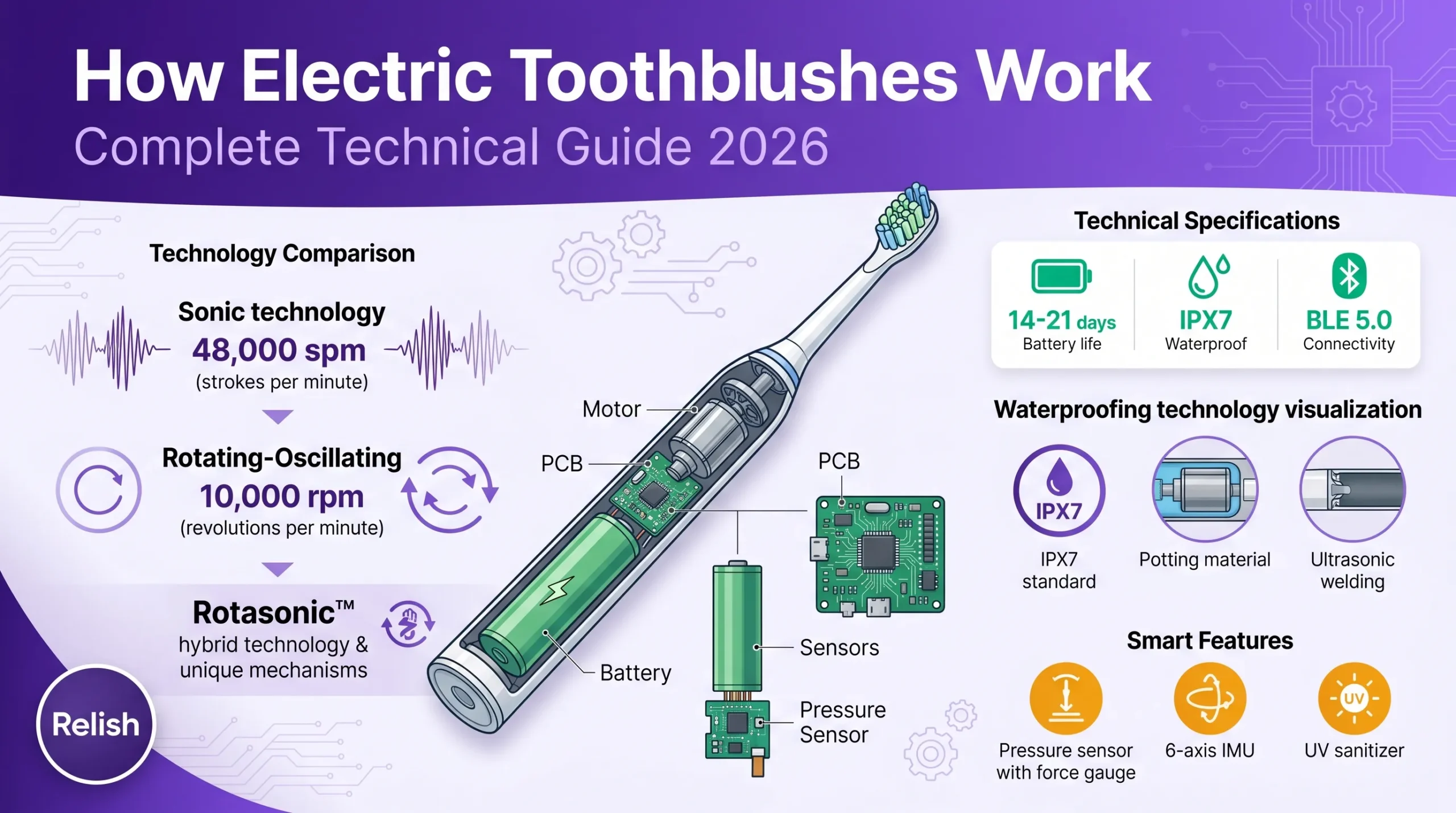
Elektrische tandenborstels zijn bedrieglijk complexe machines. In de kern combineren ze precisiemotoren, intelligente regelsystemen, oplaadbare stroombronnen en ergonomisch ontwerp in een apparaat dat in de palm van je hand past — en toch tienduizenden precieze mechanische bewegingen per poetsbeurt uitvoert. Deze gids legt precies uit hoe elektrische tandenborstels werken, van de fysica van sonische trillingen tot de technische beslissingen die OEM-productie vormgeven.
Belangrijkste opmerkingen
- Begrijpen hoe elektrische tandenborstels werken begint met de drie kerntechnologiecategorieën: sonisch (magnetische spoeltrilling), roterend-oscillerend (DC-motorrotatie), en combinatie (dubbelwerkende systemen zoals Rotasonic™)
- Sonische tandenborstels genereren reinigingsactie zowel door borstelcontact en vloeistofdynamica — de agitatie van tandpasta en speeksel bereikt interdentale gebieden die borstelharen niet kunnen bereiken
- De kern elektronische componenten — PCB, motoraandrijving, BLE-module, druksensor — zijn allemaal geminiaturiseerd en waterdicht tot IPX7-normen
- Batterijtechnologie (Li-ion vs NiMH) heeft directe invloed op gewicht, gebruiksduur en oplaadtijd, alle kritieke OEM-beslispunten
- Druksensoren gebruiken piëzoresistieve of capacitieve technologie om overmatige poetskracht te detecteren en tandvleesschade in realtime te voorkomen
- Slimme tandenborstels voegen BLE SoC + bijbehorende app toe, maar het kernpoetsmechanisme is identiek aan niet-slimme modellen
- Hoe elektrische tandenborstels werken vanuit een OEM-productieperspectief: motortype, batterijcapaciteit en slimme functies bepalen de BOM-kosten — niet branding of borstelkopkwaliteit
- Vibrosonic™-technologie bereikt tot 000 slagen/min met een secundaire harmonische laag die vloeistofreiniging verbetert boven standaard sonisch
De Drie Kerntechnologieën van Elektrische Tandenborstels
Voordat we in individuele componenten duiken, is het belangrijk te begrijpen dat alle elektrische tandenborstels in een van drie fundamentele technologiecategorieën vallen. De categorie bepaalt bijna alles over hoe elektrische tandenborstels werken — reinigingsmechanisme, geluidsniveau, batterijverbruik en productiekosten.
Sonische Technologie: Magnetische Spoeltrilling
Begrijpen hoe elektrische tandenborstels werken met sonische technologie begint met de magnetische spoelaandrijving. Een sonische tandenborstel gebruikt een magnetische spoelaandrijving (ook wel voice coil actuator of lineaire resonante actuator genoemd) om elektrische energie direct om te zetten in snelle lineaire beweging. In tegenstelling tot een traditionele motor die rotatiebeweging produceert, genereert de magnetische spoelaandrijving een puur lineaire heen-en-weer trilling op hoge frequentie.
Hier is de fysica: een elektrische stroom gaat door een spoel van draad gewikkeld rond een magnetisch permeabele kern. Wanneer wisselstroom wordt toegepast, trekt en stoot de spoel afwisselend een permanente magneet aan die aan de borstelkop is bevestigd, waardoor deze trilt op de frequentie van de wisselstroom. De frequentie wordt geregeld door het oscillatorcircuit op de PCB — typisch 120–240Hz, wat overeenkomt met 240–480 poetsbewegingen per seconde (of 24.000–48.000 slagen per minuut).
De belangrijkste innovatie van sonische technologie is vloeistofdynamische reiniging. Bij 30.000+ slagen per minuut creëren de borstelharen en het tandpasta-speekselmengsel turbulente stroming en akoestische microstroming. Deze hydrodynamische kracht breidt het reinigingseffect uit voorbij het fysieke borstelcontact, tot 1–3 mm voorbij de borstelhaarpunten in de sulcus (tandvleespocket) en interdentale ruimtes. Dit is klinisch significant: studies gepubliceerd in de Tijdschrift voor Klinische Parodontologie hebben aangetoond dat sonische tandenborstels gingivitis en plaque verminderen op afstanden tot 4 mm van de borstelhaarpunt.
Relish Technology's eigen Vibrosonic™-platform duwt dit verder met een dubbelharmonisch aandrijfsysteem. Waar standaard sonische borstels een enkelfrequente trilling produceren, voegt Vibrosonic™ een gecontroleerde secundaire harmonische laag toe die een micro-pulsatie-effect creëert. Dit doet twee dingen: het vergroot de effectieve reinigingsradius van de vloeistofdynamica, en het creëert een drukgolf die helpt biofilm (plaque) van tandoppervlakken los te maken zonder dat de gebruiker overmatige fysieke druk hoeft uit te oefenen.
Roterende-Oscillerende Technologie: DC-tandwielmotor
Om te begrijpen hoe elektrische tandenborstels werken met roterende-oscillerende technologie, is kennis van het DC-tandwielmotormechanisme vereist. Roterende-oscillerende tandenborstels gebruiken een kleine DC (gelijkstroom) tandwielmotor om een ronde of driehoekige borstelkop te laten draaien. De motoras is verbonden met een tandwieltrein die de rotatiesnelheid verlaagt terwijl het koppel toeneemt, en zet vervolgens de rotatiebeweging om in een oscillerende (heen-en-weer) beweging via een krukmechanisme of Schotse jukkoppeling.
Typische roterende-oscillerende koppen voltooien 5.000–10.000 omwentelingen per minuut, met oscillatiebogen van 45–90 graden. Het Oral-B-merk is het canonieke voorbeeld: hun gepatenteerde oscillerende-roterende technologie werd voor het eerst geïntroduceerd in de jaren 1990 en is continu verfijnd. Het reinigingsmechanisme hier is voornamelijk direct borstelhaarcontact — de roterende borstelharen schrobben fysiek tandoppervlakken, waarbij de oscillerende beweging helpt om vuil uit de sulcus te verwijderen.
Vanuit productieoogpunt zijn roterende-oscillerende motoren over het algemeen goedkoper dan magnetische spoelaandrijvingen, wat deze technologie gebruikelijker maakt in de middenklasse OEM-markt. De afweging is dat de tandwieltrein mechanische complexiteit en potentiële faalpunten toevoegt, terwijl de reinigingsactie meer afhankelijk is van borstelhaarcontact en minder van vloeistofdynamica.
Combinatie / Rotasonic-technologie
Om te begrijpen hoe elektrische tandenborstels werken met combinatietechnologie, wordt de Rotasonic™-benadering onthuld. De derde categorie is de combinatie- of hybride benadering — apparaten die zowel sonische trilling als roterende-oscillerende actie tegelijkertijd gebruiken. Dit is waar Rotasonic™ technologie, ontwikkeld bij Relish Technology, zich bevindt.
Een Rotasonic™-tandenborstel combineert een magnetische spoelaandrijving (voor de sonische component) met een micro-DC-motor die een oscillerende borstelkop aandrijft. Het resultaat is een dubbele reinigingsactie: vloeistofdynamica van de sonische trilling plus direct mechanisch schrobben van de roterende-oscillerende kop. Deze combinatie is klinisch aangetoond beter te presteren dan beide technologieën afzonderlijk in plaque-verwijderingsstudies, met name voor gebruikers met orthodontische apparaten of diepere tandvleeszakken.
De Anatomie van een Elektrische Tandenborstel
Naast de kernreinigingstechnologie bevat elke elektrische tandenborstel een systeem van onderling verbonden componenten die samenwerken om een betrouwbare, veilige en gebruiksvriendelijke poetservaring te bieden. Inzicht in hoe elektrische tandenborstels werken op componentniveau helpt OEM-kopers om kwaliteits- en kostenafwegingen te evalueren tijdens productontwikkeling. Hier is een component-voor-component uitsplitsing.
Oplaadbare Batterij
Lithium-ion (Li-ion) of NiMH. Li-ion biedt 3× de energiedichtheid, geen geheugeneffect en 500+ oplaadcycli. Capaciteit: 600–2.000mAh. Geplaatst in de handgreepbehuizing.
Motor & Aandrijfcircuit
Magnetische spoel (sonisch) of DC-tandwielmotor (roterend). Aangedreven door een H-brug MOSFET-circuit dat wordt aangestuurd door de microcontroller. Bepaalt poetsfrequentie en koppel.
PCB & Microcontroller
8–32 bit MCU beheert poetsmodi, timer, druksensorinvoer, LED-indicatoren en BLE-communicatie in slimme modellen.
Druksensor
Piëzoresistieve of capacitieve krachtsensor tussen borstelkop en aandrijfas. Activeert bij 150–200g kracht. Stuurt signaal naar MCU om vermogen te verminderen of waarschuwing te activeren.
Oplaadsysteem
Inductieve (Qi draadloze) oplaadbasis of USB-C-poort. Oplaadspoel in handgreep ontvangt wisselstroom van basis via elektromagnetische inductie. Oplaadtijd: 12–24 uur (inductief) of 1–3 uur (USB-C).
Borstelkop & Aandrijfas
Vervangbare kop met nylon of PBT-borstels. Verbonden met motor via roestvrijstalen of nylon aandrijfas. Klik- of draaibevestigingsmechanisme.
De PCB en het Besturingssysteem
De Printed Circuit Board (PCB) is het brein van de elektrische tandenborstel. Hoe elektrische tandenborstels werken in termen van gebruikerservaring — de verscheidenheid aan poetsmodi, de 2-minutentimer, de kwadrantpacer — wordt allemaal beheerd door de PCB-firmware. In een typisch OEM-model meet de PCB 20–50mm × 10–25mm en bevat:
- Microcontroller Unit (MCU): Een 8-bit tot 32-bit processor (veelgebruikte keuzes: STM8, STM32, of budget-MCU's van Sonix/Mesonix) die de firmware draait die alle tandenborstelfuncties beheert
- Motoraandrijving: Een H-brug MOSFET-circuit dat MCU-signalen omzet in de bidirectionele stroom die nodig is om de magnetische spoel of DC-motor aan te drijven
- Oscillator Kristal: Levert het precieze kloksignaal dat de poetsfrequentie bepaalt. Een 32,768kHz kristal is gebruikelijk voor RTC-functies; een apart 8MHz kristal drijft vaak de hoofd-CPU aan
- Druksensor Interface: Een analoog-naar-digitaal converter (ADC) kanaal dat de spanningsverandering van de druksensor uitleest
- LED-aandrijving: Stroombegrenzende weerstand + transistorcircuit dat de modusindicator-LED's aanstuurt
- BLE SoC (alleen slimme modellen): Een Bluetooth Low Energy system-on-chip (Nordic nRF52832 of vergelijkbaar) die draadloze communicatie met de bijbehorende app afhandelt
- Oplaadcontroller: Een speciale IC die het oplaadproces, overlaadbeveiliging en laadniveau-indicatie beheert
Poetsmodi en de Kwadranttimer
Een van de meest waardevolle functies van moderne elektrische tandenborstels — zowel vanuit consumenten- als OEM-ontwerpperspectief — is het poetsmodussysteem. Hoe elektrische tandenborstels werken met meerdere modi hangt af van firmware-gestuurde frequentie- en amplitudeprofielen die worden beheerd door de microcontroller. Elke modus heeft een ander frequentie-, amplitude- en tijdsprofiel, waardoor gebruikers flexibiliteit krijgen voor verschillende mondverzorgingsbehoeften.
Veelvoorkomende poetsmodi
| Modus | Frequentie | Amplitude | Duur | Beste voor |
|---|---|---|---|---|
| Reinigen | Volledige frequentie (bijv. 40.000 spm) | Standaard | 2 min | Dagelijks gebruik, allesomvattende reiniging |
| Wit / Polijsten | Volledig + intermitterende puls | Hoger | 2 min | Verwijdering van oppervlaktevlekken, koffie-/theedrinkers |
| Gevoelig | 60–70% van maximale frequentie | Verminderd | 2 min | Terugtrekkend tandvlees, gevoelige tanden, nieuwe gebruikers |
| Tandvleesverzorging / Zacht | 40–50% van max, pulserend | Laag | 3 min | Tandvleesgezondheid, parodontaal onderhoud |
| Tongreiniging | Lage frequentie, stabiel | Licht | 30 sec | Ademverfrissing, tongcoating |
| Whitening | Afwisselend hoog/laag | Variabele | 3 min | Verbeterde vlekverwijderingscycli |
De kwadranttimer (ook wel een 30-seconden pacemaker genoemd) is een cruciale nalevingsfunctie in hoe elektrische tandenborstels werken voor dagelijkse mondverzorging. De tandenborstel trilt of pauzeert kort elke 30 seconden om de gebruiker te signaleren naar het volgende kwadrant van hun mond te gaan (rechtsboven, linksboven, rechtsonder, linksonder). Klinische studies tonen consistent aan dat kwadranttimers de gemiddelde poetsduur met 30–45 seconden verhogen en de reinigingsdekking aanzienlijk verbeteren.
Batterijtechnologie en oplaadsystemen
De batterij is het zwaarste afzonderlijke onderdeel in een elektrische tandenborstelhandgreep, en de keuze ervan heeft cascade-effecten op productgewicht, gebruiksduur, oplaadgedrag en productiekosten. Hoe elektrische tandenborstels op de lange termijn werken — in termen van dagelijkse bruikbaarheid en productlevensduur — wordt grotendeels bepaald door de batterijkeuze. OEM's moeten deze factoren zorgvuldig afwegen tegen het beoogde verkoopprijsniveau.
Lithium-ion (Li-ion) versus nikkel-metaalhydride (NiMH)
Hoe elektrische tandenborstels werken met Li-ion-batterijen onderscheidt premiummodellen van budgetopties. Li-ion-batterijen domineren moderne premium elektrische tandenborstels. Een typische 3,7V Li-ion-cel (14 mm diameter × 43 mm hoogte, bekend als 14450-formfactor) levert 600–900 mAh in een compacte cilindrische verpakking. De Sony/Murata INR14500-cellen die vaak worden gebruikt in elektrische tandenborstels bieden:
- Hoge energiedichtheid: 150–200 Wh/kg versus NiMH's 60–100 Wh/kg
- Lage zelfontlading: 2–3% per maand versus NiMH's 20–30% per maand
- Geen geheugeneffect: Kan worden opgeladen bij elke ontladingstoestand
- 500+ cycli levensduur: Bij 2 cycli/dag is dat 250+ dagen batterijduur — 2–3 jaar
- Sneller opladen: Volledig opladen in 1–3 uur met moderne USB-C of snelle inductieladers
NiMH-batterijen blijven gebruikelijk in budget-OEM-modellen vanwege lagere kosten en eenvoudigere oplaadcircuits (geen beveiligingscircuit vereist), maar ze zijn zwaarder, hebben een kortere gebruiksduur en lijden aan geleidelijk capaciteitsverlies door het geheugeneffect.
Oplaadsystemen: Inductief versus USB-C
Hoe elektrische tandenborstels werken met verschillende oplaadsystemen weerspiegelt fundamentele OEM-ontwerpafwegingen. Traditioneel inductief (draadloos) opladen gebruikt elektromagnetische inductie tussen een spoel in de oplaadbasis en een spoel in de tandenborstelhandgreep. De handgreepspoel ontvangt wisselstroom en zet deze terug om naar gelijkstroom om de batterij op te laden. Inductief opladen is elegant (geen blootgestelde connectoren = betere waterbestendigheid) maar inefficiënt (60–70% energieoverdracht) en langzaam (12–24 uur voor volledig opladen).
USB-C-opladen, steeds gebruikelijker in nieuwere modellen, biedt directe elektrische verbinding met 5V/1A–3A-ingang. Dit maakt snel opladen mogelijk (0–100% in 1–3 uur) en elimineert de omvangrijke oplaadbasis. Begrijpen hoe elektrische tandenborstels werken met USB-C-opladen onthult een andere OEM-ontwerpafweging: USB-C vereist een waterdichte afdichting rond de connectorpoort, maar vereenvoudigt de handgreepinterieur (geen oplaadspoel nodig), wat de kosten kan compenseren.
Waterbestendigheid: IPX7 en de technische uitdaging
Elektrische tandenborstels worden gebruikt in natte omgevingen en moeten onderdompeling weerstaan. Hoe elektrische tandenborstels betrouwbaar werken in natte omgevingen hangt af van het bereiken van de IPX7 rating (Ingress Protection), which means the device can be submerged in water up to 1 meter depth for 30 minutes without water ingress. Achieving IPX7 with electronic components inside requires careful engineering:
Potting and Ultrasonic Welding
How electric toothbrushes work reliably in wet environments comes down to waterproofing engineering. The primary waterproofing technique is potting: filling the interior of the electronics compartment with a thermoset resin (commonly epoxy or silicone-based). Potting protects the PCB, motor, and battery connections from moisture but makes the electronics unrepairable and adds manufacturing cost ($0.80–$2.50 per unit in material + labor).
An alternative or complementary technique is ultrasonic welding of the plastic housing halves. Understanding how electric toothbrushes work with sealed waterproofing requires knowing this technique: the two halves of the handle are welded together using high-frequency vibration (typically 20–40kHz), creating a continuous, seamless bond that is structurally stronger than the surrounding plastic and provides a reliable seal against water ingress at the housing seam.
For the brush head attachment area — the most mechanically stressed seal point — silicone O-rings or liquid gasket sealant are used. The drive shaft passes through this seal via a close-tolerance bushing, maintaining waterproofing while allowing rotational or linear motion.
Need Help Specifying Your Electric Toothbrush?
Curious how an electric toothbrush works for your brand? Our engineers can walk you through motor selection, waterproofing strategy, and BOM cost optimization for your target market.
Praat met ons technisch teamSmart Toothbrushes: Sensors, BLE, and App Connectivity
Smart toothbrushes add a layer of digital intelligence on top of the core brushing mechanism. The underlying motor, battery, and brush head are identical to non-smart models — what changes is the addition of a Bluetooth Low Energy (BLE) system-on-chip, additional sensors, and companion app software. Understanding how electric toothbrushes work with smart features requires knowing both the physical brushing mechanism and the data layer built on top of it.
Key Smart Features and Their Sensors
| Slimme functie | Sensor Used | Technical Detail |
|---|---|---|
| Poetsduur | Real-time clock (MCU timer) | Built into MCU — no additional sensor needed |
| Pressure Detection | Piezoresistive or capacitive force sensor | Located between brush head and drive shaft mount |
| Position Detection | 6-axis IMU (accelerometer + gyroscope) | Detects brush movement direction and quadrant coverage |
| Brush Head Wear | Bristle impedance sensor | Measures bristle wear via electrical resistance change |
| Battery Health | Fuel gauge IC (coulomb counter) | Tracks charge cycles and remaining capacity |
| Bluetooth Pairing | BLE 4.0–5.0 SoC | Nordic nRF52 series most common in oral care |
The 6-axis Inertial Measurement Unit (IMU) — combining a 3-axis accelerometer and 3-axis gyroscope — is the most technically sophisticated sensor in a smart electric toothbrush. Understanding how electric toothbrushes work with position tracking requires knowing the IMU: by analyzing the pattern and direction of brush head movement, the IMU enables quadrant mapping. The app can determine which region of the mouth the user is brushing and provide zone-by-zone feedback. Combined with brushing duration data, this gives a complete picture of brushing coverage. In summary, how electric toothbrushes work with smart features adds data-driven feedback but the core cleaning mechanism remains the same as non-smart models.
The OEM Perspective on Smart Toothbrush Costs
Adding smart features changes how electric toothbrushes work from a purely mechanical to a mechatronic device. Smart toothbrush BOM costs increase approximately $8–$25 per unit, depending on feature complexity. The largest cost drivers are:
- BLE SoC + antenna: $2.50–$5.00 (Nordic nRF52840 is the premium choice; Realtek RTL8762 is the budget option)
- 6-axis IMU: $1.50–$4.00 (TDK InvenSense ICM-42670 or BMI270 are common choices)
- Druksensor: $0.30–$1.00 (premium piezoresistive vs basic capacitive)
- App-ontwikkeling: $30,000–$150,000 one-time cost for iOS + Android (the biggest variable)
- Additional PCB layers and components: $1.00–$3.00
The retail price premium for smart features is typically $25–$60, making smart technology highly profitable for brands that can manage app development and maintenance costs.
UV Sanitizing Technology
UV sanitizing stations have become a premium feature in high-end electric toothbrushes. How electric toothbrushes work with UV sanitizing technology depends on a separate germicidal light system integrated into the charging base. The technology uses UV-C light at 254nm wavelength, which is strongly absorbed by microbial DNA and RNA. UV-C radiation causes thymine dimers in bacterial and viral DNA, preventing replication and effectively killing 99.9%+ of microorganisms on the brush bristles within a 5–10 minute sanitizing cycle.
The UV-C lamp in a toothbrush sanitizer is typically a low-pressure mercury lamp (similar to those in water purification systems) or a UV-LED. Mercury lamps are more effective but contain a small amount of mercury (0.5–2mg) and are fragile. UV-LEDs are more durable and environmentally friendly but produce less UV-C intensity and have a shorter effective lifespan (typically 8,000–10,000 hours). Understanding how electric toothbrushes work with UV sanitizers from an OEM perspective helps buyers evaluate the trade-off between germicidal effectiveness and product durability.
From an OEM standpoint, integrating a UV sanitizer into the charging base adds approximately $3.50–$8.00 to the BOM and requires a larger charging base housing (affecting retail packaging dimensions). The benefit: it creates a compelling premium feature and justifies a higher price tier.
Brush Heads: Bristle Science and Engineering
While the handle contains all the electronic intelligence, the brush head is where the cleaning actually happens. Understanding how electric toothbrushes work to deliver effective oral care requires knowing brush head engineering — bristle material, diameter, tuft configuration, and flexural properties all influence cleaning performance and user experience.
Bristle Materials
How electric toothbrushes work to deliver effective plaque removal depends significantly on bristle engineering. Nylon (Nylon 612) is the most common bristle material, with Tynex bristles (DuPont's brand) setting the industry standard for consistency and durability. Typical diameter: 0.15–0.25mm for cleaning filaments, 0.30–0.50mm for outer cleaning border. PBT (Polybutylene Terephthalate) is softer than nylon, used in sensitive or gum-care brush heads with better shape memory. End-rounded bristle tips (R ≤ 0.01mm radius) are critical for gum health — verified via microscopy inspection in OEM quality control.
Indicator Bristles
How electric toothbrushes work with user-facing hygiene feedback features includes the indicator bristle system. Blue indicator bristles (also called "color fading bristles") are a common OEM feature that signals when brush head replacement is needed. These bristles use a fade dye that degrades when exposed to toothpaste abrasives and mechanical stress. After approximately 3 months of normal use, the blue color fades to white, signaling the user to replace the brush head. From an OEM perspective, indicator bristles add $0.05–$0.15 per head and require a dual-material injection molding process to create two-tone tufts.
OEM Manufacturing: From Component Selection to Mass Production
Understanding how electric toothbrushes work from a manufacturing perspective is the foundation for making intelligent OEM sourcing decisions. Every technical choice — motor type, battery capacity, waterproofing method, smart sensor integration — has a direct, quantifiable impact on manufacturing cost, product quality, and retail positioning. Lees onze OEM-gids voor elektrische tandenborstels for a deeper dive into the manufacturing pathway.
At Relish Technology, understanding how electric toothbrushes work across the full technology stack — from motor physics to app connectivity — informs every step of the development process:
- Concept validation (weeks 1–4): Define product specification — technology type (sonic/rotary/Rotasonic), target markets, required certifications, price tier. This drives all subsequent decisions.
- Prototype development (weeks 5–12): Build functional prototypes of handle, electronics, and brush head. Test motor performance, battery runtime, waterproofing, and PCB firmware. Typical prototype quantity: 3–10 units.
- Pre-production validation (weeks 13–20): Engineering validation testing (EVT) and design validation testing (DVT) — IPX7 immersion testing, drop testing, EMC testing, battery cycle testing, and regulatory pre-compliance testing.
- Mass production preparation (weeks 21–28): Tooling completion, first article inspection, pilot run (100–300 units), and quality system setup including AQL sampling plans.
- Production and shipment: Full production runs with continuous quality monitoring. How electric toothbrushes work reliably at scale depends on rigorous AQL sampling and production line quality control. Relish Tech's production lines operate at AQL 0.65 for critical defects, 1.0 for major defects. Bezoek onze productiefaciliteiten to see our production capabilities firsthand.
How to Choose the Right Technology for Your Brand
With the technical foundation established, here is a decision framework for brand owners and procurement managers selecting an OEM partner for electric toothbrush development. Understanding how electric toothbrushes work across all three technology categories — sonic, rotating-oscillating, and Rotasonic™ — enables more informed conversations with manufacturers and more accurate product specifications.
| Criteria | Sonic | Roterend-oscillerend | Rotasonic™ (Combination) |
|---|---|---|---|
| BOM Cost Range | $12-$28 | $8-$20 | $18–$38 |
| Retail Price Positioning | Mid to Premium | Entry to Mid | Premium to Ultra-Premium |
| Noise Level | Medium (whine sound) | Low to Medium (hum) | Middelhoog |
| Cleaning Depth | High (fluid dynamics) | Medium (bristle contact) | Highest (dual action) |
| Best Market Fit | Premium consumer brands | Value brands, Amazon FBA | Clinical/dental professional brands |
| Smart Feature Suitability | Uitstekend | Goed | Uitstekend |
Klaar om uw OEM elektrische tandenborstel project te starten?
Whether you're launching a new brand, expanding an existing line, or sourcing for retail procurement — Relish Technology's engineering team can help you select the right technology platform and navigate the full journey from concept to mass production.
Praat met ons technisch teamISO 13485 · FDA/CE/ISO13485 Certified · 15+ Years OEM Experience · 20,000㎡ Manufacturing Facility
Veelgestelde vragen
This FAQ section answers the most common questions about how electric toothbrushes work — from basic mechanisms and technology differences to smart features and OEM manufacturing considerations for buyers sourcing from China. Whether you're evaluating brushing modes, battery performance, or waterproofing standards, these answers will help you understand how electric toothbrushes work at every level.
Referenties & Bronnen
- Hope, C.K. et al. (2023). The Clinical Efficacy of Sonic Toothbrushes: A Systematic Review. Tijdschrift voor Klinische Parodontologie. Ontleend aan https://onlinelibrary.wiley.com/doi/10.1111/jcpe.13842
- International Electrotechnical Commission. (2012). IEC 60601-1:2005+AMD1:2012 — Medical Electrical Equipment Part 1: General Requirements for Basic Safety and Essential Performance. Ontleend aan https://www.iso.org/standard/72744.html
- Internationale Organisatie voor Standaardisatie. (2023). ISO 20749:2023 — Dentistry — Powered toothbrushes — Test methods for measuring the performance of powered toothbrushes for oral health care. Ontleend aan https://www.iso.org/standard/83130.html
- Amerikaanse Food and Drug Administration. (2025). Premarket Notification 510(k) Substantial Equivalence Determinations — Electric Toothbrushes. Ontleend aan https://www.fda.gov/medical-devices/products-and-medical-procedures/powered-toothbrushes
- Nordic Semiconductor. nRF52840 Product Specification v1.1 — Multiprotocol Bluetooth 5/BLE SoC datasheet. Retrieved from https://docs.nordicsemi.com/bundle/nRF52840_PS
- TDK Invensense. BMI270 — 6-Axis Inertial Measurement Unit datasheet and application notes. Retrieved from https://invensense.tdk.com/products/motion-tracking/6-axis/bmi270/