
Controllo Qualità Spazzolino Elettrico:
Guida QC OEM 2026
Una panoramica completa del processo di controllo qualità degli spazzolini elettrici in una fabbrica OEM di livello mondiale per l'igiene orale — che copre IQC, IPQC, OQC, test di impermeabilità, standard delle setole e ispezione pre-spedizione.
Benchmark dei tassi di difetto basati su registrazioni QC documentate presso lo stabilimento produttivo certificato ISO 13485 di Relish Technology (Shenzhen, 2024–2025).
Punti Chiave
- I produttori cinesi di spazzolini elettrici di alto livello raggiungono tassi di difetto inferiori allo 0,3% attraverso un controllo qualità a tre livelli: IQC → IPQC → OQC
- Il test funzionale al 100% di ogni unità finita è irrinunciabile — il solo campionamento è insufficiente per l'elettronica
- La causa principale dei guasti sul campo è batterie non conformi da fornitori non qualificati — verificare sempre la certificazione UN 38.3 dai fornitori indicati (ATL, EVE, BYD, Samsung SDI)
- L'impermeabilità IPX7 richiede test in camera di immersione in fabbrica — verificare che questa attrezzatura esista prima di ordinare spazzolini elettrici
- L'arrotondamento delle punte delle setole deve superare 90% secondo le linee guida ADA — questo è un comune fallimento qualitativo nelle fabbriche a basso costo che producono spazzolini elettrici
- L'ispezione pre-spedizione (SGS/Bureau Veritas) su ordini superiori a 1.000 unità protegge dalla sostituzione della produzione durante il processo di controllo qualità degli spazzolini elettrici
Il controllo qualità nella produzione di spazzolini elettrici è più complesso di quanto la maggior parte dei proprietari di marchi si aspetti. A differenza dei beni di consumo passivi, gli spazzolini elettrici sono dispositivi elettromeccanici che devono funzionare in modo affidabile in ambienti umidi — e vengono messi nella bocca delle persone. Le conseguenze di un fallimento qualitativo sono gravi: resi Amazon e recensioni negative a breve termine, azioni normative e danni alla reputazione del marchio a lungo termine.
Comprendere il processo di controllo qualità degli spazzolini elettrici ti consente di porre le giuste domande quando valuti i fornitori OEM e di stabilire requisiti qualitativi contrattuali che proteggano il tuo marchio. Questa guida spiega ogni fase, dall'introduzione delle materie prime al carico del container.
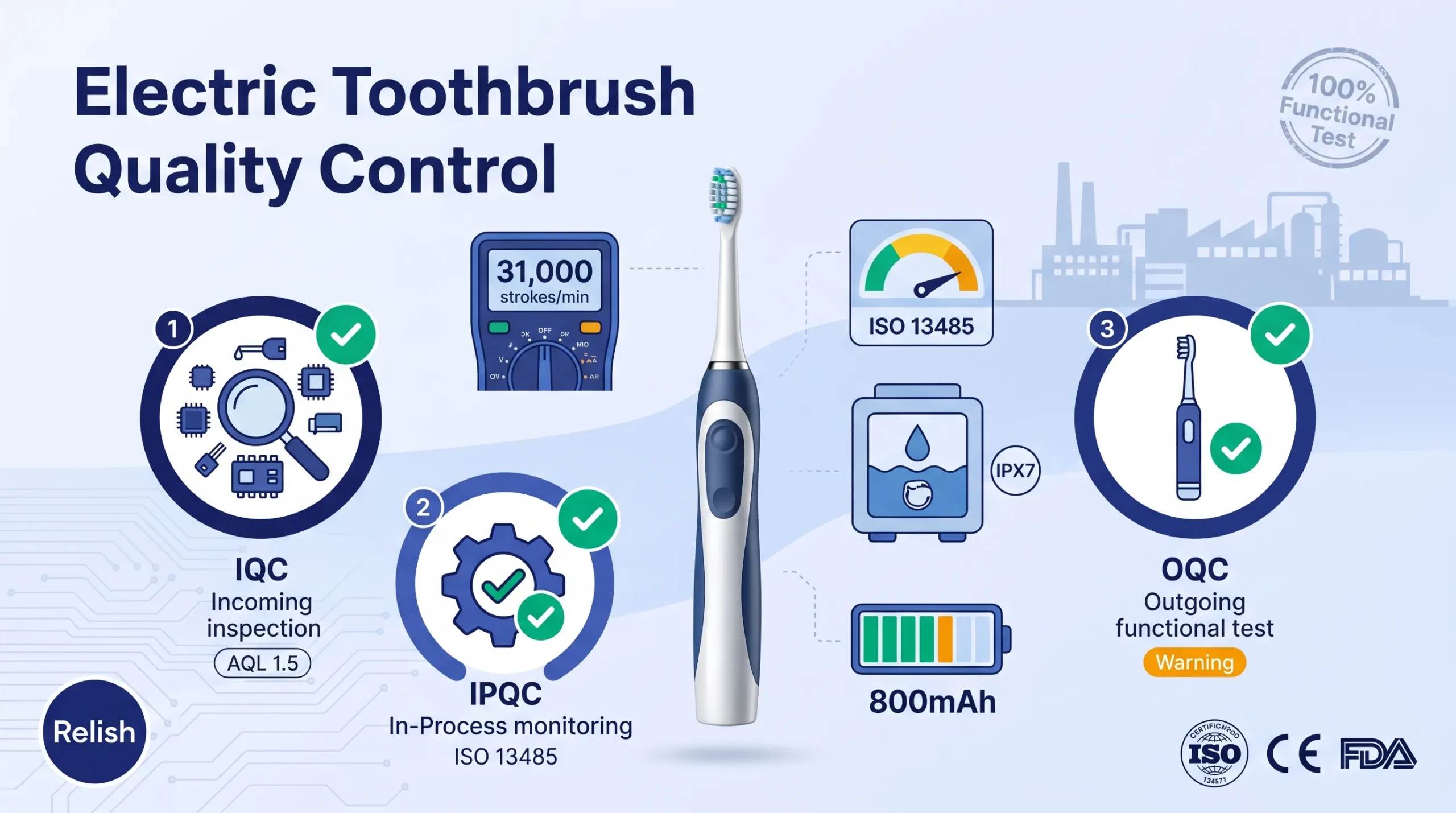
Il Quadro di Controllo Qualità a 3 Livelli per Spazzolini Elettrici: IQC → IPQC → OQC
Un sistema di gestione della qualità completo per la produzione OEM di spazzolini elettrici copre tre fasi distinte della produzione:
Fase 1: Controllo Qualità in Entrata (IQC) per Spazzolini Elettrici
L'IQC è la prima e più strategica fase del controllo qualità degli spazzolini elettrici. I componenti non conformi che superano l'IQC diventano prodotti finiti difettosi — costosi da riparare e potenzialmente impossibili da richiamare una volta spediti.
Componenti Critici che Richiedono Ispezione IQC al 100%
| Componente | Test Chiave | Criteri di Accettazione | Priorità |
|---|---|---|---|
| Motore DC (sonico) | Frequenza di vibrazione (Hz), RPM, livello di rumore, assorbimento di corrente | 000±500 colpi/min; <45dB; corrente entro specifica | Critico |
| Batteria agli Ioni di Litio | Capacità (mAh), tensione, durata del ciclo, temperatura; richiesto certificato di prova UN 38.3 | Entro il 5% della capacità nominale; richiesto certificato UN 38.3 | Critico |
| PCB / Controllo Elettronico | Continuità del circuito, funzione timer, commutazione modalità | Tutte le funzioni secondo specifica; nessun giunto saldato a freddo | Critico |
| Corpo Maniglia (iniezione) | Tolleranze dimensionali, finitura superficiale, corrispondenza colore | Tolleranze ±0,2mm; corrispondenza colore Pantone | Maggiore |
| Setole in Nylon | Diameter (mm), material (food-grade nylon), end-rounding per ADA guidance | Soft: 0.15mm; Medium: 0.2mm; >90% ball-tipped ends | Critico |
| IPX Sealing Components | O-ring dimensions, material elasticity, seating geometry | Shore A hardness 60–70; no gaps on assembly jig | Critico |
| Charger / Charging Base | Output voltage, current regulation, CE/UL mark | 5V±0.25V; 1A±0.1A; certified marks present | Critico |
Stage 2: In-Process Quality Control (IPQC) for Electric Toothbrush Manufacturing
IPQC monitors quality as units are being assembled during the electric toothbrush manufacturing process. Problems caught during IPQC cost far less to fix than those discovered after full assembly. The most advanced factories use Statistical Process Control (SPC) to detect quality drift before defects occur.
IPQC Checkpoints by Production Stage
| Stage | IPQC Check | Method | Frequenza |
|---|---|---|---|
| Motor Installation | Torque spec, mounting alignment, wire routing | Torque wrench, visual | Every 50 units |
| PCB Assembly | Automated optical inspection (AOI), solder joint quality per IEC 60335 safety standards | AOI machine + visual | 100% AOI |
| Battery Installation | Polarity, seating, weld quality | Visual + continuity test | 100% |
| Handle Assembly | Snap-fit torque, gap dimensions, cosmetic appearance | Go/No-Go gauge, visual | Every 100 units |
| Bristle Tufting | Tuft count, anchoring force, end-rounding confirmation per ADA guidance | Pull test, microscope sample | Every 200 heads |
| IPX Seal Assembly | O-ring seating, compressed air leak test per IEC 60529 IP Code | Pressure decay tester | 100% |
| Label/Branding Application | Position, adhesion, legibility, regulatory text accuracy | Visual + go/no-go template | Every 50 units |
Statistical Process Control (SPC)
SPC uses real-time data from production to detect trends before they become defects. Top-tier factories track control charts for critical parameters (motor frequency, IPX seal pressure, battery voltage) and trigger corrective action when readings approach control limits — before any defective unit is made.
Stage 3: Outgoing Quality Control (OQC) — 100% Functional Testing for Electric Toothbrushes
OQC is the final quality gate before products enter packaging. 100% functional testing — not sampling — is the standard for electronics in the electric toothbrush quality control process. Sampling finished units allows defective products to reach customers; 100% testing catches every unit that fails before it ships.
Functional Test Specs
Waterproofing Tests
Appearance Standards
Packaging Verification
Need a Manufacturer with Proven Electric Toothbrush Quality Control?
Relish Technology operates an ISO 13485-certified 20,000㎡ facility with documented defect rates below 0.3%. Request a QC sample order today.
Request QC Sample Order →Defect Classification System for Electric Toothbrush Quality Control
Defects are classified into three levels that determine how they are handled in the electric toothbrush quality control process:
| Class | Definition | Examples | Action | AQL Level |
|---|---|---|---|---|
| Critico | Safety risk or regulatory non-compliance | Battery failure, waterproofing breach, electrical shock risk, incorrect voltage | 100% rejection, root cause analysis required | AQL 1.5 (0 tolerance) |
| Maggiore | Functional failure affecting usability | Motor below spec, missing brushing mode, timer malfunction, bristle shedding | Batch hold, rework or reject | AQL 1.5 |
| Minore | Cosmetic defect not affecting function | Surface scratch (not on grip), minor color variation, packaging crease | Record and release with written approval | AQL 2.5 |
Bristle Quality: The Most Overlooked QC Factor in Electric Toothbrush Manufacturing
Bristle quality is frequently underspecified by brand owners and under-inspected by factories manufacturing electric toothbrushes. Yet bristle quality directly affects dental outcomes and drives some of the most common consumer complaints.
Bristle End-Rounding: The ADA Standard
Il ADA (American Dental Association) requires that at least 90% of bristle ends are properly rounded (ball-tipped) for a toothbrush to receive ADA endorsement. Un-rounded bristle ends are sharp and cause gum abrasion — this is a primary cause of negative reviews and dental professional complaints.
Proper end-rounding requires a separate mechanical ball-tipping process after bristle cutting. Low-cost factories skip this step to reduce per-unit cost. Always request microscope inspection photos of bristle ends as part of your electric toothbrush quality control protocol — this is explicitly required by the ADA endorsement program.
Pre-Shipment Inspection: Your Last Line of Defense
A pre-shipment inspection by an accredited third party (SGS, Bureau Veritas, Intertek) provides an independent quality verification after production is complete (typically when 80–100% of goods are finished and packaged). For orders above 1,000 units, this investment is essential for any electric toothbrush quality control strategy.
What a Pre-Shipment Inspection Should Cover
- Random sample selection from cartons (AQL 2.5 for cosmetic defects)
- Functional testing: vibration frequency, all modes, timer, charging
- Waterproof test (IPX5 minimum for every sample)
- Packaging accuracy: barcode scan, manual language, label accuracy for destination market
- Carton drop test (1.2m onto each face)
- Quantity count against commercial invoice
- Documentation check: CE Declaration, FDA labeling, UN 38.3 for battery transport
Domande frequenti
Source from a Factory with <0.3% Defect Rate
Relish Technology's three-stage QC system, ISO 13485 certification, and 15 years of OEM experience deliver the quality your brand depends on. Request a factory audit and sample order today.
Request Samples & QC Report →Riferimenti e fonti
- ISO. (2016). ISO 13485:2016 — Medical devices — Quality management systems. Estratto da https://www.iso.org/standard/59752.html
- ANSI/ASQ. (2008). Z1.4-2008: Sampling Procedures for Inspection by Attributes. American Society for Quality. Retrieved from https://webstore.ansi.org/Standards/ASQ/ANSIZ12008
- IEC. (2020). IEC 60335-2-52: Safety — Oral hygiene appliances. International Electrotechnical Commission. Retrieved from https://www.iec.ch/
- ADA (American Dental Association). (2023). Toothbrush Endorsement Program Technical Requirements. ADA.org. Recuperato da https://www.ada.org/
- IEC. (2021). IEC 60529: Degrees of protection provided by enclosures (IP Code). International Electrotechnical Commission. Retrieved from https://www.iec.ch/basecamp/pyramid/