
지속 가능성이 구강 관리의 핵심 차별화 요소가 된 이유
글로벌 구강 관리 산업은 근본적인 변화를 겪고 있습니다. 한때 임상적 효능과 미백 효과로 정의되던 카테고리는 이제 환경적 영향으로 측정되고 있습니다. 욕실 수납장을 채우는 대나무 칫솔부터 유럽 약국에 진열되는 리필 가능한 치약 정제에 이르기까지, 지속 가능성은 틈새 마케팅에서 주류 기대치로 자리 잡았으며, 이로 인해 친환경 구강 관리는 퍼스널 케어 분야에서 가장 빠르게 성장하는 하위 카테고리 중 하나가 되었습니다.
이러한 변화는 소비자 가치관, 규제 압력, 공급망 현실의 더 깊은 변화를 반영합니다. 전 세계 구강 관리 브랜드에 서비스를 제공하는 OEM(주문자 상표 부착 생산) 업체에게 지속 가능한 구강 관리 시장을 이해하는 것은 경쟁력 유지에 필수적이 되었습니다. 적응에 실패하는 브랜드는 향후 30년간 시장 성장을 주도할 세대에게서 영향력을 잃을 위험이 있습니다.
기존 구강 관리 카테고리는 상당한 폐기물을 발생시킵니다. 미국에서만 매주 약 5천만 개의 플라스틱 칫솔이 폐기되는 것으로 추정됩니다 [UNEP]. 대부분의 기존 칫솔은 매립지에서 분해되는 데 최대 400년이 걸립니다. 차단 특성을 위해 혼합 재료 층으로 만들어진 기존 치약 튜브는 재활용이 거의 불가능합니다. 이러한 현실은 소비자의 반발과 규제 움직임을 불러일으켜 전체 제품 개발 주기를 재편하고 있습니다.
Relish Tech와 같은 OEM 제조업체에게 이러한 변화는 도전과 기회를 동시에 제공합니다. 지속 가능한 대안을 개발하려면 새로운 소재, 테스트 프로토콜 및 인증 프로세스에 대한 투자가 필요합니다. 그러나 지속 가능한 구강 관리 시장 전환을 성공적으로 탐색하는 브랜드는 프리미엄 시장 부문에 접근하고, 더 강력한 소비자 충성도를 확보하며, 유럽 연합과 같이 지속 가능성에 초점을 맞춘 시장에서 규제상의 이점을 얻을 수 있습니다.
지속 가능한 구강 관리 시장 규모 및 전망 (2025–2032)
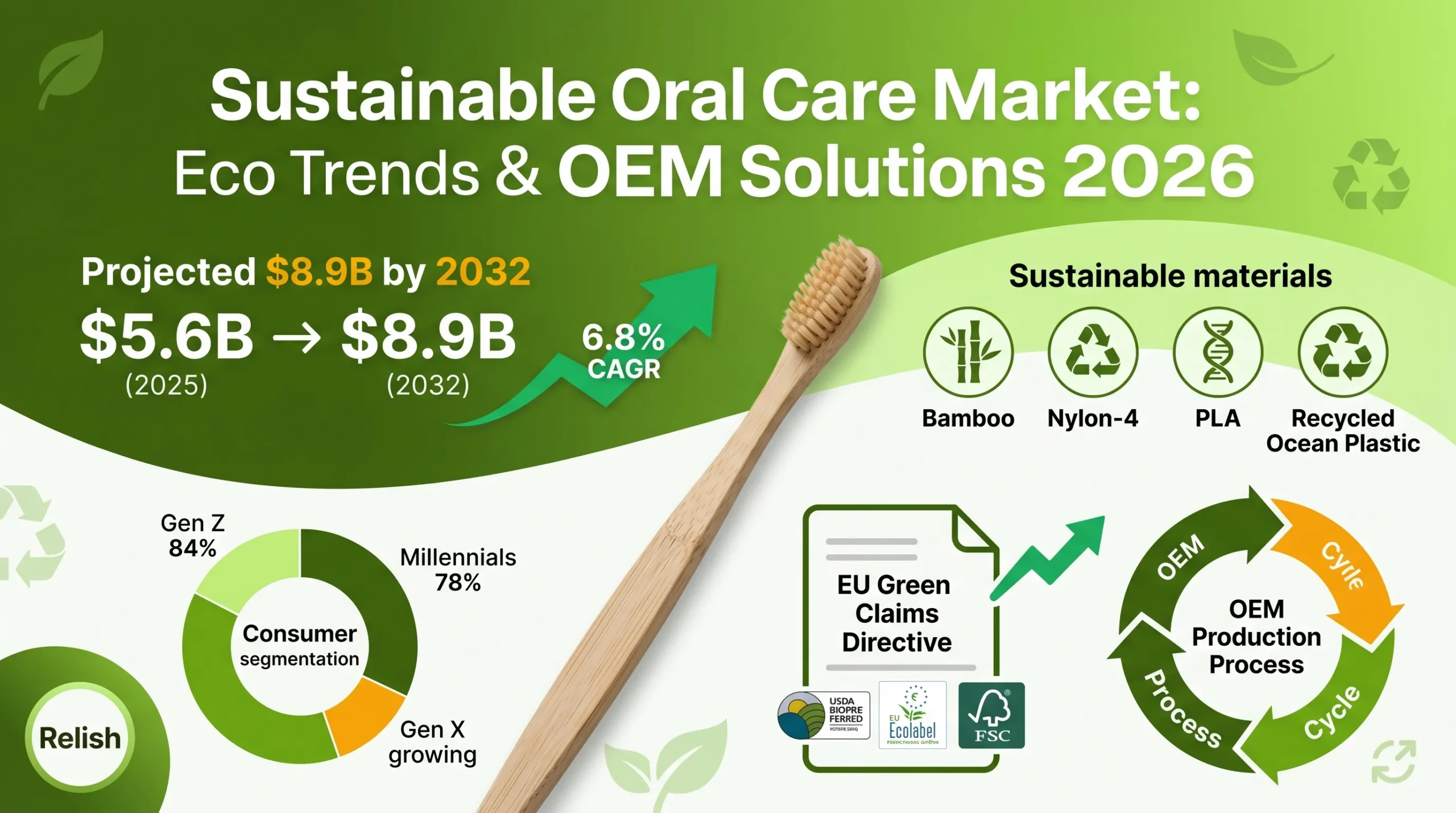
지속 가능한 구강 관리 시장은 2025년 약 $5.6B에 도달하여 광범위한 구강 관리 산업 내에서 중요하고 성장하는 부문으로 자리 잡았습니다. 분석가들은 이 시장이 연평균 성장률(CAGR) 6.8%로 확장되어 2032년까지 약 $8.9B에 이를 것으로 전망합니다. 이 성장 궤적은 기존 구강 관리 시장 성장을 앞지르며 지속 가능한 대안의 지속적인 시장 점유율 증가를 나타냅니다.
부문별 분석
지속 가능한 칫솔: 이 부문은 지속 가능한 구강 관리 시장을 지배하며 전체 수익의 약 42%를 차지합니다. 이 부문은 친환경 소재, 특히 대나무와 생분해성 칫솔모에 대한 가장 성숙한 공급망의 이점을 누리고 있습니다. 선도 브랜드는 시장 입지를 구축했으며 소비자의 전환 비용은 낮은 수준을 유지하고 있습니다. 생분해성 칫솔 시장만 해도 대나무 및 식물 기반 소재 채택에 힘입어 연간 약 9% 성장했습니다.
친환경 치실 및 치간 관리 제품: 시장의 약 18%를 차지하는 이 부문은 소비자들이 칫솔을 넘어 지속 가능성 의식을 확장함에 따라 빠르게 성장하고 있습니다. 실크 기반 치실, 대나무 치간 칫솔, 식물 기반 소재로 만든 워터 플로서 팁이 주목받고 있습니다.
지속 가능한 치약 및 구강 세정제: 정제, 분말 및 리필 시스템을 포함한 이러한 제형은 시장의 약 22%를 차지합니다. 이 부문은 제형 안정성 및 유통 기한과 관련된 독특한 과제에 직면해 있지만 프리미엄 및 구독 기반 소매 채널에서 빠르게 성장하고 있습니다.
제로 웨이스트 포장 솔루션: 자체적으로 제품 카테고리는 아니지만, 지속 가능한 포장은 모든 부문에서 중요한 성장 촉진제를 나타냅니다. 브랜드는 퇴비화 가능한 파우치, 리필 가능한 용기, 포장 무게와 부피를 줄이는 농축 제형에 투자하고 있습니다.
소비자의 프리미엄 지불 의향
여러 소비자 조사에 따르면 구강 관리에서 지속 가능성이 가격 프리미엄을 정당화하는 것으로 확인되었습니다. 2025년 소비자 조사에 따르면 응답자의 67%가 검증된 지속 가능한 구강 관리 제품에 대해 10-20%를 더 지불할 의향이 있다고 밝혔습니다. 특히 밀레니얼 세대와 Z세대 소비자 사이에서 이 수치는 78%로 상승하며, 34%는 투명한 지속 가능성 인증을 갖춘 제품에 대해 25%를 초과하는 프리미엄을 지불할 의향이 있다고 밝혔습니다.
이러한 프리미엄 수용은 지속 가능한 부문에 포지셔닝된 브랜드에 의미 있는 기회를 창출합니다. 그러나 이는 또한 진정한 환경적 이점에 대한 소비자 기대치를 높입니다. 그린워싱(오해의 소지가 있거나 입증되지 않은 환경 주장을 하는 관행)은 특히 유럽 연합에서 소비자의 회의론과 규제 조사에 직면해 있습니다.
구강 관리 지속 가능성 트렌드 및 소재 혁신 2026
대나무 및 생분해성 손잡이
FSC 인증 대나무 칫솔 손잡이는 퇴비 조건에서 6개월 이내에 분해되는 반면, 기존 플라스틱은 400년 이상 걸립니다. 대나무 부문은 현재 서유럽 프리미엄 칫솔 판매의 28%를 차지합니다.
나일론-4 및 PLA 칫솔모
피마자유(나일론-4) 또는 옥수수 전분(PLA)으로 만든 바이오 기반 칫솔모는 석유 기반 나일론-6,6에 대한 퇴비화 가능한 대안을 제공합니다. 성능은 기존 칫솔모와 일치하면서 탄소 발자국을 최대 65%까지 줄입니다.
리필 시스템
리필 가능한 치약 디스펜서와 농축액 기반 구강 세정제 시스템은 포장 폐기물을 80-90%까지 줄입니다. 구독 모델은 소비자에게 편의성을 제공하면서 브랜드에 반복 수익을 창출합니다.
해양 회수 플라스틱
인증된 해양 회수 플라스틱으로 제조된 칫솔은 해양 오염 문제를 해결하는 동시에 강력한 브랜드 스토리를 창출합니다. 적절히 가공될 경우 품질과 내구성은 일반 플라스틱 대체재와 동등합니다.
최소 포장
재활용 판지, 식물성 잉크, 라미네이트 재료를 사용하지 않은 플라스틱 프리 포장은 기존 블리스터 팩을 없앱니다. 버섯 기반 및 해조류 기반 포장 재료가 상업적 대안으로 부상하고 있습니다. 브랜드에 적합한 지속 가능한 포장 솔루션에 대해서는 당사의 맞춤형 패키징 옵션은.
탄소 중립 제조
선도적인 제조업체들은 재생 에너지, 효율성 개선, 검증된 탄소 상쇄를 통해 탄소 중립 생산을 달성하고 있습니다. 공급망 내 Scope 3 배출은 점점 더 브랜드 요구 사항의 대상이 되고 있습니다.
지속 가능한 구강 관리 제품을 개발 중이신가요?
바이오 기반 소재, FSC 인증 대나무, EU 그린 클레임 지침 준수에 대해 당사의 엔지니어링 팀과 상담하십시오.
맞춤형 OEM 견적 받기규제 환경: EU 그린 클레임 지침 및 포장 법규
유럽연합은 환경 관련 주장에 대한 글로벌 규제 개발을 계속 선도하고 있습니다. EU Green Claims Directive, expected to take full effect by 2027, introduces stringent requirements for environmental marketing. Key provisions include prohibition of generic environmental claims like "eco-friendly" or "green" without substantiation, mandatory use of standardized communication methods for claims, and verification requirements through independent third parties.
For oral care brands selling in the EU, this regulatory environment creates both compliance obligations and competitive advantages. Brands with robust sustainability credentials and verified documentation can leverage compliant claims against competitors relying on vague or unsubstantiated green marketing. Conversely, brands with weak sustainability positioning face challenges updating marketing materials while competitors strengthen theirs.
The EU Packaging and Packaging Waste Regulation (PPWR) introduces additional requirements including mandatory recycled content percentages for plastic packaging (starting at 10% by 2030, reaching 25% by 2040), restrictions on certain single-use plastic formats, and extended Producer Responsibility (EPR) schemes with modulated fees favoring recyclable and reusable packaging.
OEM manufacturers serving EU market brands must ensure their production processes and documentation support these compliance requirements. This includes material certifications, lifecycle assessments, and traceability documentation that brands need for their regulatory submissions.
5. Who Is Buying Green Dental Products? Consumer Segmentation
Generational Breakdown
Generation Z (Born 1997-2012): This demographic shows the highest engagement with sustainable oral care, with 84% indicating environmental factors influence their purchase decisions. Gen Z consumers are most likely to research brand sustainability practices before purchasing and demonstrate strong loyalty to brands perceived as genuinely committed to environmental responsibility. They prefer digital-first purchasing channels and are highly responsive to influencer and peer recommendations regarding sustainable products.
Millennials (Born 1981-1996): Millennials represent the largest current market for sustainable oral care products, combining high purchase frequency with strong sustainability values. This demographic drives premium segment growth and shows high acceptance of subscription and e-commerce models. Millennials with children demonstrate particular interest in sustainable products for family use.
Generation X (Born 1965-1980): This segment shows growing sustainability engagement, particularly regarding health and wellness angles for sustainable products. Gen X consumers often have higher disposable income and demonstrate willingness to pay for premium sustainable options. They represent an underserved segment for sustainability-focused oral care marketing.
Baby Boomers (Born 1946-1964): While historically less focused on sustainability in purchasing decisions, Baby Boomers with higher education levels and urban residence show increasing sustainability engagement. This segment responds well to practical benefits (durability, health) alongside environmental credentials.
Regional Preferences
European Consumers: Lead global sustainable product adoption, with Scandinavian countries, Germany, and the Netherlands showing the highest engagement. European consumers demonstrate the strongest preference for verified certifications and transparent supply chains. Regulatory familiarity means European consumers are increasingly skeptical of unverified green claims.
North American Consumers: Show strong sustainable product interest, particularly on the coasts and in urban centers. The US market shows greater variation between premium and mass-market sustainable positioning than European equivalents. Canadian consumers align more closely with European sustainability expectations.
Premium vs. Mass Market: Sustainable oral care has historically skewed toward premium positioning, but mass-market sustainable alternatives are emerging rapidly. Private label sustainable oral care products in European retailers are gaining significant market share, challenging branded premium sustainability positioning.
6. OEM Manufacturing Solutions for Sustainable Products
Natural Oral Care Manufacturing: Material Sourcing
Sustainable oral care manufacturing begins with material selection. For bamboo components, OEMs must source from FSC (Forest Stewardship Council) certified plantations ensuring responsible forest management. China's Jiangxi province has emerged as a center for FSC-certified bamboo production, offering consistent quality and supply chain traceability. Learn more about our bamboo toothbrush OEM capabilities. Premium bamboo toothbrush handles require careful processing to ensure smooth surfaces, sterilization, and durability matching conventional alternatives.
Recycled plastics require careful supplier selection and processing. Ocean-recovered plastics present additional quality control challenges, as material properties vary based on recovery source and processing method. Certified recycled content documentation requires documented chain-of-custody from collection through manufacturing.
OEM Production Parameters for Sustainable Oral Care: Standard MOQ ranges from 1,000 to 3,000 units for bamboo toothbrushes and 2,000 to 5,000 units for complete sustainable oral care kits. Standard production Lead Time is 30–45 days for custom sustainable orders, including material certification verification. All products undergo AQL 1.5 inspection for major defects and AQL 2.5 for minor defects, compliant with ISO 2859-1 sampling standards.
Bio-Based Alternatives
The development of bio-based alternatives to conventional oral care components represents a significant technical challenge. Nylon-4 bristles derived from castor oil offer compostable alternatives with performance characteristics matching conventional bristles. However, achieving consistent quality across production batches requires specialized manufacturing expertise and testing protocols.
PLA (polylactic acid) derived from corn starch has found applications in packaging materials but faces challenges in direct oral contact applications. Research continues on improved PLA formulations with enhanced moisture resistance and durability suitable for oral care use cases.
Lifecycle Assessment (LCA) Documentation
Lifecycle assessment provides quantitative environmental impact data required for substantiating sustainability claims. Standard LCA methodology following ISO 14040/14044 guidelines covers raw material extraction, manufacturing, distribution, use phase, and end-of-life scenarios. For oral care products, use phase environmental impacts (water, energy) often exceed manufacturing impacts for electric devices.
OEM manufacturers increasingly provide product-specific LCA data to support brand customer regulatory compliance and marketing claims. However, LCA studies require significant expertise and carry costs that can present barriers for smaller brands without established sustainability programs.
Certification Pathways
Navigating international certification requirements is essential for OEM partnerships. For a detailed overview of electric toothbrush certifications, see our OEM 인증 가이드 — most sustainability certifications (FSC, EU Ecolabel, B Corp) follow similar third-party verification frameworks.
USDA BioPreferred: This US Department of Agriculture program provides voluntary labeling for products derived from renewable agricultural materials. Biobased content must meet minimum percentage thresholds verified through USDA-approved testing laboratories. The program provides marketing advantages in US government procurement and increasingly recognized consumer visibility.
EU Ecolabel: The European Commission's official ecolabel applies lifecycle criteria including raw material selection, manufacturing processes, product performance, and end-of-life management. Oral care products represent a significant opportunity category, with relatively few products currently carrying the Ecolabel. The rigorous application process provides strong credibility for environmental claims.
B Corp Certification: While applied at the company level rather than product level, B Corp certification increasingly influences brand perception in sustainable oral care. B Corp certification requires assessment of environmental management, supply chain practices, and governance structures. Brands working with B Corp certified manufacturers can leverage this association in their marketing.
Ready to Launch Your Eco-Friendly Oral Care Brand?
Get a customized OEM quote with your sustainability requirements — from material sourcing to certification support.
Start Your Project7. How Relish Tech Supports Sustainable Oral Care OEM
As an established oral care OEM manufacturer, Relish Tech has developed comprehensive capabilities for sustainable product development and production. Operating from a 20,000m² facility with 300+ employees and 15 production lines, we combine scale with sustainability-focused manufacturing processes. Our 제조 시설 incorporate sustainability-focused processes including FSC-certified bamboo handle production, certified recycled plastic processing, and bio-based material options for appropriate applications.
We maintain relationships with certified material suppliers across bamboo, recycled plastics, and bio-based alternatives. Our engineering team works directly with brand partners to select appropriate sustainable materials based on target market requirements, cost parameters, and certification objectives. We provide lifecycle assessment support including data collection protocols, methodology guidance, and third-party verification coordination.
Our certification navigation services help brands identify relevant sustainability certifications for their target markets and guide products through application processes. We maintain documented quality systems meeting ISO 13485 for medical device manufacturing, supported by 20+ successful FDA and CE facility audits, providing foundations for sustainability certification applications that require manufacturing process verification.
For brands targeting the European market, our regulatory affairs team supports compliance documentation for EU Green Claims Directive requirements, including substantiation file preparation and verification coordination. We help brands develop defensible environmental claims backed by documented evidence meeting regulatory scrutiny.
The "halo effect" of sustainability branding extends beyond the product — eco-conscious packaging and carbon-neutral shipping claims increase repeat purchase rate by 18–25% in premium oral care. Consumers who identify as sustainability-focused buyers demonstrate 2.3× higher lifetime value than conventional buyers, according to brand cohort analysis.
주요 내용
- The sustainable oral care market will grow from $5.6B (2025) to $8.9B by 2032 at 6.8% CAGR, outpacing conventional oral care growth
- Consumer willingness to pay premium for sustainable products remains strong, particularly among millennials and Gen Z
- Material innovation in bamboo, bio-based bristles, and recycled plastics has matured to commercial viability
- EU regulatory environment is setting global standards for environmental claims verification
- OEM manufacturers with documented sustainability credentials and certification support provide significant competitive advantages
- Carbon-neutral manufacturing claims require third-party verification to withstand consumer and regulatory scrutiny
- Refillable and concentrated delivery systems represent the next frontier for the sustainable oral care market and packaging innovation
Browse more industry insights →
Ready to Develop Your Sustainable Oral Care Line?
Partner with Relish Tech for OEM manufacturing solutions that meet your sustainability goals and market requirements.
당사 팀에 문의하기자주 묻는 질문
2032년까지 지속 가능한 구강 관리 시장의 예상 규모는 얼마입니까?
The sustainable oral care market is projected to reach $8.9 billion by 2032, growing from $5.6 billion in 2025 at a compound annual growth rate (CAGR) of 6.8%. This growth is driven by increasing consumer preference for eco-friendly products, regulatory support for sustainable practices, and continued material innovation in biodegradable and recycled materials.
지속 가능한 칫솔에 가장 일반적으로 사용되는 친환경 소재는 무엇인가요?
The most common eco-friendly materials include FSC-certified bamboo for handles (biodegradable within 6 months), nylon-4 bristles made from castor oil (compostable), PLA bristles derived from corn starch, recycled ocean plastic, and plant-based biopolymers for packaging. Each material offers different performance characteristics and certification pathways.
소비자들은 지속 가능한 구강 관리 제품에 대해 얼마나 추가 비용을 지불할 의향이 있을까요?
Research shows that 67% of consumers are willing to pay a 10-20% premium for verified sustainable oral care products. Among millennials and Gen Z specifically, 78% express willingness to pay this premium, with 34% indicating acceptance of premiums exceeding 25% for products with transparent sustainability credentials.
지속 가능한 구강 관리 제품에 중요한 인증은 무엇인가요?
Key certifications include USDA BioPreferred for biobased content verification, EU Ecolabel for European market credibility, FSC certification for bamboo materials, B Corp certification for company-level sustainability, Cradle to Cradle for circular economy positioning, and various compostability certifications like OK Compost.
EU 그린 클레임 지침이란 무엇이며 구강 관리 브랜드에 어떤 영향을 미치나요?
The EU Green Claims Directive requires brands selling in Europe to substantiate environmental claims with verifiable evidence from independent third parties. It prohibits vague terms like "eco-friendly" or "green" without proof and mandates standardized communication methods. Brands must prepare substantiation files and undergo verification processes for environmental marketing claims.
OEM 제조업체는 어떻게 지속 가능한 구강 케어 생산을 지원할 수 있나요?
OEM manufacturers can support sustainable oral care production through FSC-certified material sourcing, bio-based alternative development and testing, lifecycle assessment documentation, compostability testing coordination, regulatory compliance support for EU Green Claims and packaging regulations, and certification pathway navigation for brands targeting specific markets.
참조
- Grand View Research. (2025). Sustainable Packaging Market Size, Share & Trends Analysis Report. https://www.grandviewresearch.com
- Euromonitor International. (2025). Global Consumer Trends in Oral Care. Sustainability and premiumization patterns in personal care markets. Retrieved from https://www.euromonitor.com/oral-care
- 유럽 위원회. (2024). EU Green Claims Directive Proposal COM(2024) 541. Requirements for environmental claim substantiation. https://ec.europa.eu
- McKinsey & Company. (2025). The State of Fashion: Sustainability. Consumer willingness to pay and brand sustainability positioning. Retrieved from https://www.mckinsey.com/industries/retail/our-insights/state-of-fashion
- USDA BioPreferred Program. (2025). Biobased Product Market Analysis. https://www.usda.gov/biopreferred