
Wanneer u inkoopt kenmerken van elektrische tandenborstels voor uw merk, krijgt u te maken met een duizelingwekkende reeks opties in verschillende modellen en prijsklassen. Sommige functies verbeteren de gebruikerservaring echt. Andere verhogen de productiekosten zonder evenredige waarde. De uitdaging voor OEM-kopers is het scheiden van het zinvolle van de marketingpraat.
Deze gids ontleedt elke belangrijke functie van een elektrische tandenborstel vanuit een productieperspectief. We behandelen wat elke functie daadwerkelijk doet, hoe het de productiekosten beïnvloedt en hoe u kunt beslissen welke functies van elektrische tandenborstels in uw productlijn passen—geen hype, alleen praktische besluitvorming.
Belangrijkste opmerkingen
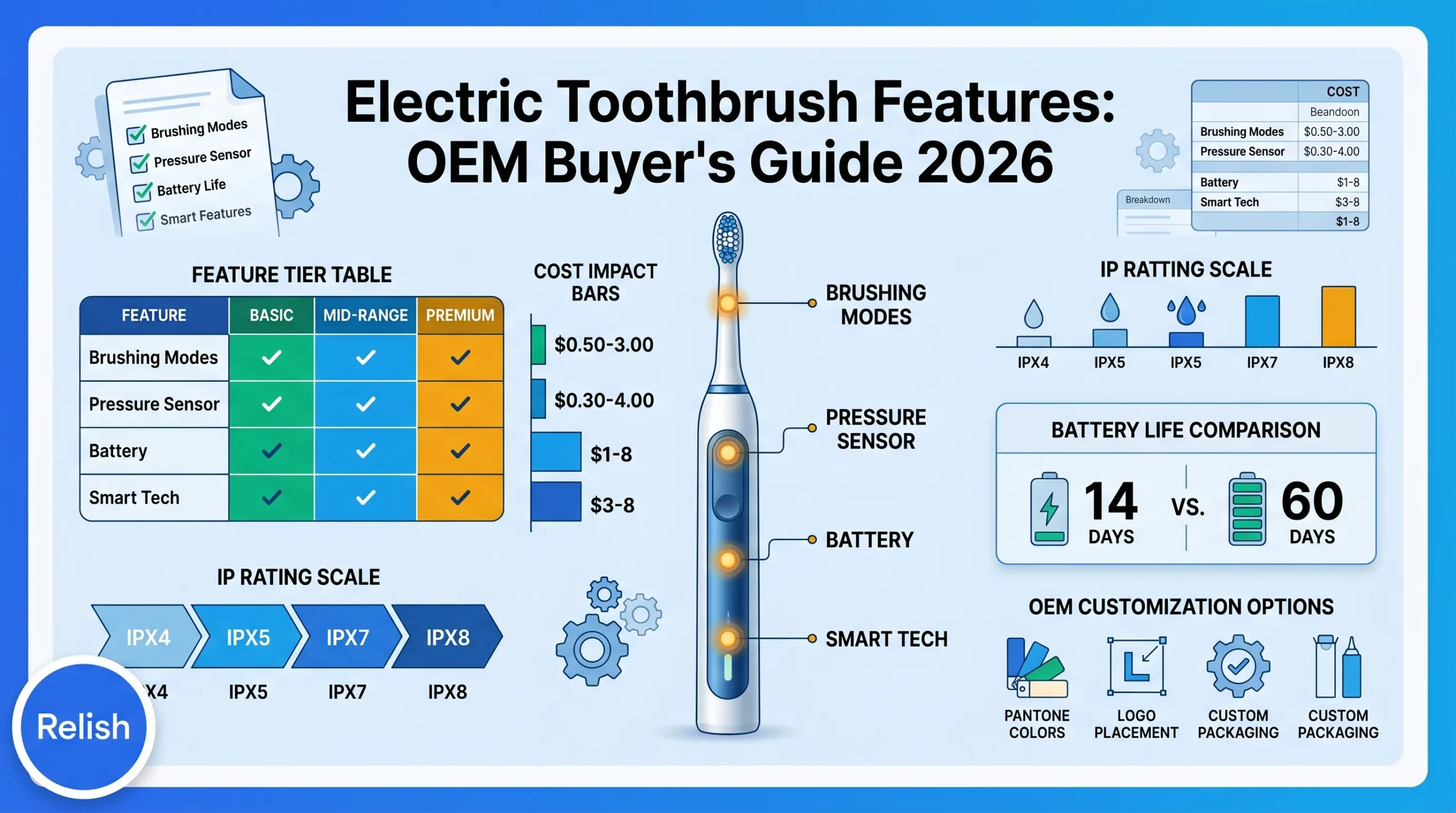
- Functies van elektrische tandenborstels voegen $0,50–$8,00/stuk toe aan de BOM-kosten, afhankelijk van de complexiteit van poetsstanden en slimme connectiviteit
- Druksensoren verminderen claims voor tandvleesschade en garantiekosten; optische sensoren voegen $1.50–$3.00 toe versus basis mechanische sensoren
- Batterijduur (14–60 dagen) heeft direct invloed op klanttevredenheid en retourpercentages; lithium-ion kost 2–3× meer dan Ni-MH
- Slimme functies (Bluetooth, app-connectiviteit) voegen $3,00–$8,00/stuk toe, maar zorgen voor een premium positionering voor technologisch vooruitstrevende merken
- Functies van elektrische tandenborstels zoals timers, quadpacers en druksensoren zijn klinisch gevalideerd voor poetseffectiviteit; kosten zijn verwaarloosbaar ($0,20–$0,50) maar worden vaak over het hoofd gezien door OEM-kopers
- OEM elektrische tandenborstel aanpassingsopties—logoplaatsing, kleurafstemming, modusbenaming—voegen doorgaans 5–15% toe aan de stukprijs, maar zorgen voor sterke merkdifferentiatie
Poetsstanden: De Eerste Functies van Elektrische Tandenborstels Waarover U Moet Beslissen
Inzicht in Modusarchitectuur
De meeste elektrische tandenborstels bieden meerdere poetsstanden, die elk een ander vibratiepatroon of intensiteitsniveau vertegenwoordigen. De onderliggende technologie drijft zowel de productiekosten als de door de consument ervaren waarde van deze belangrijke kenmerken van elektrische tandenborstels:
Enkelmodusborstels (alleen reinigingsmodus): Eenvoudigste PCB-programmering, laagste kosten. Gebruikelijk in budgetproducten onder $25 adviesprijs.
Multimodusborstels: PCB regelt de motoroutput over 2–6 verschillende patronen. Elke extra modus voegt programmeercomplexiteit en testvereisten toe.
Adaptieve/slimme borstels: Motoren passen zich in realtime aan op basis van invoer van de druksensor, wat oneindig variabele reiniging binnen één modus biedt. Hoogste kosten, maar beste gebruikerservaring.
Veelvoorkomende Poetsstanden Uitgelegd
Reinigingsmodus
De basislijn. Volledige vibratiefrequentie (doorgaans 31.000–40.000 vpm voor sonisch, 7.500–10.500 opm voor oscillerend-roterend) voor dagelijks gebruik. Geen extra kosten—elke tandenborstel bevat deze modus.
Gevoelige Modus
Verminderde vibratie-intensiteit (doorgaans 60–70% van het volledige vermogen) met zachtere borstelbeweging. Essentieel voor gebruikers met tandvleesrecessie, glazuurerosie of recent tandheelkundig werk. Vanuit productieperspectief is dit slechts een andere PWM-instelling (pulsbreedtemodulatie)—kostenimpact is verwaarloosbaar.
Whitening/Polish Modus
Intermitterende hoogintensieve pulsen ontworpen om oppervlaktevlekken te verwijderen. Werkt door mechanische impact in plaats van chemische werking. Voegt kleine PCB-complexiteit toe.
Tandvleesverzorging/Massage Modus
Laagfrequente pulserende beweging die tandvleesweefsel stimuleert. Claims zijn meestal anekdotisch, maar de functie spreekt de 35+ demografie aan die bezorgd is over parodontale gezondheid. Geen significante productiekostenverschil met de reinigingsmodus.
Tongreinigingsmodus
Gespecialiseerde laagfrequente vibratie voor tongschraperopzetstukken. Alleen relevant als uw productlijn compatibele tongverzorgingsaccessoires bevat.
Kostenimpact per Aantal Standen
| Aantal Standen | PCB-complexiteit | Productiekosten toevoegen | Aanbevolen Voor |
|---|---|---|---|
| 1 (Alleen reinigen) | Basis | $0 | Budgetpositionering |
| 2–3 standen | Standaard | $0,50–$1,00 | Middenmarkt |
| 4–5 standen | Geavanceerd | $1,50–$2,50 | Premium midden |
| 6+ standen | Slim | $3.00+ | Premium/technisch |
Strategische aanbeveling
Voor de meeste OEM-merken, 3–4 standen raakt de juiste balans: reinigen, gevoelig en whitening of tandvleesverzorging. Dit dekt 90% van de consumentenbehoeften zonder onnodige kosten toe te voegen. Als u zich richt op de markt voor gevoelige tanden (vaak oudere consumenten met tandheelkundig werk), maak dan de gevoelige stand de standaard of voeg een speciale knop toe. Onze OEM elektrische tandenborstelgids behandelt hoe de standenselectie uw BOM-kostenstructuur beïnvloedt.
Druksensoren
Waarom druksensoren ertoe doen
Druksensoren detecteren wanneer gebruikers te hard poetsen—doorgaans gedefinieerd als >150g kracht—en geven feedback om tandvleesschade en glazuurslijtage te voorkomen. Het klinische voordeel is goed gedocumenteerd: overmatige poetstijd is een belangrijke oorzaak van tandvleesrecessie en tandgevoeligheid. Deze kritische kenmerken van elektrische tandenborstels hebben direct invloed op de consumententevredenheidsscores.
Vanuit zakelijk perspectief verminderen druksensoren:
- Garantieclaims door motoruitval (agressief poetsen belast de motor)
- Klachten van klanten over tandvleesbloedingen of gevoeligheid
- Retourpercentages: interne merkgegevens geven aan dat tandenborstels met druksensoren meetbaar lagere retourpercentages hebben op e-commerceplatforms (interne kwaliteitscontrole)
Soorten druksensoren
Mechanische/contactsensoren
Basisontwerp: borstelharen duwen tegen een fysiek contact dat activeert bij ingestelde drukdrempels. Eenvoudig, betrouwbaar, lage kosten ($0,30-$0,80).
Optische sensoren
Geavanceerder: infrarood-LED's detecteren borstelhaarafbuiging. Kan variabele feedback geven op basis van drukintensiteit, niet alleen binair aan/uit. Kosten $1.50–$3.00 maar maken rijkere gebruikersfeedback mogelijk (geleidelijke waarschuwing vs. directe melding).
Piëzo-elektrische sensoren
Hoogste precisie: meten werkelijke kracht door materiaalrek. Te vinden in premiumproducten zoals Oral-B iO. Kosten $4.00+ maar biedt de meest nauwkeurige feedback.
OEM-kosten-batenanalyse
Voor een merk dat 10.000 eenheden/maand verkoopt tegen een gemiddelde winkelprijs van $50:
- Toevoegen van basisdruksensoren: +$0.50–$1.00/eenheid = +$5.000–$10.000/jaar productiekosten
- Vermindering van garantieretouren (schatting 5–10% reductie): bespaart $2.500–$5.000/jaar
- Verbeterde recensies die tandvleesgezondheid noemen: moeilijk te kwantificeren maar betekenisvol voor merkreputatie
Aanbeveling: Druksensoren zijn de moeite waard om zelfs op budgetlijnen op te nemen. De kosten zijn minimaal en de aansprakelijkheidsvermindering alleen al rechtvaardigt de investering. Onze productiekostengids biedt gedetailleerde BOM-uitsplitsingen voor druksensorintegratie.
Batterijduur en opladen: Kernfuncties van elektrische tandenborstels voor consumententevredenheid
Batterijtype en -capaciteit behoren tot de meest impactvolle kenmerken van elektrische tandenborstels voor consumententevredenheid en retourpercentages. De batterijkeuze heeft invloed op het hele productontwerp—van handgreeplengte en industrieel ontwerp tot oplaadtijd en verkoopprijs.
Vergeleken batterijtypen
Nikkel-metaalhydride (Ni-MH)
Verouderde technologie nog steeds gebruikelijk in budgetproducten. Typische capaciteit: 800–1.200 mAh. Vereist volledige ontlaadcycli; geheugeneffect verkort levensduur. Kosten: $1.00–$2.00 per unit.
Lithium-Ion (Li-Ion)
Standard for mid-range and premium toothbrushes. Typical capacity: 1,500–3,000 mAh. No memory effect, consistent performance until depletion. Cost: $3.00–$6.00 per unit.
Lithium Polymer (Li-Po)
Slimmer form factor than Li-Ion, enabling sleeker handle designs. Same performance characteristics. Cost: $4.00–$8.00 per unit.
Real-World Battery Life Expectations
| Batterijtype | Stated Life | Real-World Life | Full Charge Time |
|---|---|---|---|
| Ni-MH (budget) | 2 weeks | 10–14 days | 8–12 hours |
| Li-Ion (mid) | 3 weeks | 18–25 dagen | 12–16 hours |
| Li-Ion (premium) | 4+ weeks | 28–45 days | 12–16 hours |
| Li-Ion + fast charge | 3+ weeks | 21–30 days | 2-4 uur |
Note: Stated battery life assumes 2×2-minute brushing sessions daily. Real-world usage varies significantly.
Charging Solutions
Standard base charger: Inductive charging through handle base. Simple, reliable, ~$0.80–$1.50 cost.
USB charging: Directly accessible USB-C or magnetic USB port. Appeals to travelers; adds $0,50–$1,00 cost. Often preferred for hotel/travel-specific products.
Travel case with charging: Premium feature combining storage and charging. Cost $3.00–$8.00 per unit but enables $80–$120 price point positioning.
OEM Considerations
Battery choice cascades through the entire product:
- Larger battery = larger handle = different industrial design
- Charging speed affects transformer/power adapter requirements
- USB charging requires waterproof port sealing (IPX7 or higher)
- Different battery suppliers = different quality consistency
Our Shenzhen facility tests battery performance across temperature extremes (-10°C to 45°C) to ensure consistent consumer experience regardless of climate conditions.
Smart Features: Electric Toothbrush Features for the Tech-Forward Segment
Among all kenmerken van elektrische tandenborstels, Bluetooth connectivity and smart features generate the most debate among OEM buyers. These features add significant cost ($3–$8/unit + app development) but deliver premium positioning only if your target market values the technology.
Bluetooth and App Integration
Connected toothbrushes pair with smartphone apps via Bluetooth to provide:
- Real-time brushing feedback
- Brushing session history
- Gamification elements (especially for kids' models)
- Personalized coaching based on brushing patterns
Manufacturing cost impact: Bluetooth module adds $2.00–$5.00 per unit; app development and maintenance add $20,000–$50,000 annually for iOS + Android.
AI and Advanced Coaching
Newer premium products incorporate AI algorithms that:
- Detect brushing technique via accelerometer + gyroscope
- Identify missed areas
- Provide voice coaching via app
- Track long-term oral health trends
This technology is still maturing. For OEM buyers, the question is whether your brand identity supports the "tech-forward" positioning required to justify the premium cost of these kenmerken van elektrische tandenborstels.
Smart Home Integration
Some products now integrate with:
- Amazon Alexa / Google Home for voice commands
- Smart displays for real-time brushing feedback
- Health apps (Apple Health, Google Fit) for data sharing
These features remain niche but appeal to the connected home enthusiast demographic.
When Smart Features Make Sense
Include Bluetooth if:
- Your brand targets millennials or Gen-Z tech enthusiasts
- You're positioning at $80+ MSRP
- You have budget for ongoing app development/maintenance
- You want data on user behavior for product development
Skip Bluetooth if:
- You're targeting value-conscious consumers at $30–50 MSRP
- You lack resources for app development
- Your market research shows consumers find app pairing frustrating
- You're selling primarily through retail where demos are limited
Timers and Quadpacers: Essential Electric Toothbrush Features for Clinical Effectiveness
Why Timers Matter
Clinical studies consistently show that most people brush for only 45–60 seconds rather than the recommended 2 minutes. Among all kenmerken van elektrische tandenborstels, the 2-minute timer with quadpacer is the most clinically validated for improving brushing effectiveness (source: ADA official brushing recommendations).
Single timer: Vibrates or pulses at 2 minutes to signal completion. Simple, effective, nearly zero cost ($0.10–$0.20 PCB change).
Quadpacer: Divides the mouth into four quadrants (upper-right, upper-left, lower-right, lower-left) with 30-second intervals. These critical kenmerken van elektrische tandenborstels ensure even coverage and—paired with a 2-minute timer—form the clinical minimum for effective oral care. Adds minimal cost ($0,20–$0,40) but significantly improves brushing effectiveness.
The Evidence
Multiple clinical studies confirm quadpacer use improves:
- Plaque removal in posterior regions (typically neglected)
- Brushing time compliance (from ~60 seconds to 2+ minutes)
- Overall gingivitis reduction
From a brand perspective, including a quadpacer enables marketing claims around "dentist-recommended brushing patterns" and differentiates from basic budget products. The global market for electric toothbrushes continues to grow at double digits annually, driven by increasing awareness of oral health and premiumization trends (Grand View Research, 2025; Statista, 2025).
Implementation Options
Auditory feedback: Beeps or tone changes at interval transitions. Most common approach.
Vibration feedback: Distinct vibration patterns for quadrant changes. Better for noisy environments or hearing-impaired users.
Visual feedback: LED indicators on handle. Useful when app connectivity isn't available.
App integration: Smartphone notifications. Requires Bluetooth connectivity.
Brush Head Compatibility: The Economics of Electric Toothbrush Features Beyond the Handle
The Razor-and-Blade Model
Brush head replacement is a significant profit center for brands and convenience factor for consumers. The economics matter for OEM positioning:
Exclusive heads (Oral-B style): Circular heads with proprietary mounts. Forces consumers to buy your replacement heads. Higher margin but requires dedicated inventory.
Universal heads: T-shaped mount compatible with multiple brands. Easier initial sale but cannibalizes replacement head revenue.
Our approach at Relish Tech: We offer both exclusive designs for brands prioritizing margin and universal-compatible options for brands prioritizing initial conversion. Custom head molds add $2,000–$5,000 tooling cost but create genuine differentiation.
Head Features to Consider
Bristle indicators: Blue bristles that fade to indicate replacement time (typically 3 months). Cost: negligible; consumer value: high.
Bristle materials: DuPont Tynex is the industry standard for nylon bristles. Specialty materials (charcoal-infused, antibacterial) add minor cost.
Cup shapes: Flat for general cleaning, raised center for whitening, tapered for gum care. Multiple mold options add tooling costs but enable product line differentiation.
Water Resistance: A Non-Negotiable Electric Toothbrush Feature for Brand Credibility
Understanding IP Ratings
Electric toothbrushes must handle water exposure during use and occasional submersion during cleaning. Water resistance is a non-negotiable functie van een elektrische tandenborstel for any credible brand. IP ratings are standardized by the IEC (International Electrotechnical Commission):
IPX4 (Splash resistant): Protected from water splashing from any direction. Minimum standard for consumer safety.
IPX5 (Water jet resistant): Withstands low-pressure water jets. Useful for shower use.
IPX7 (Immersion resistant): Can withstand 1-meter submersion for 30 minutes. Required for full waterproofing claims.
IPX8 (Continuous immersion): For products marketed as suitable for underwater use. Rare in toothbrushes.
Manufacturing Implications
Higher IP ratings require:
- Improved gasket sealing at all entry points (handle, buttons, charging base)
- Potting compound for PCB protection
- More rigorous quality testing (pressure testing, thermal cycling)
- Cost increase: $0,50-$2,00 per unit depending on target rating
Aanbeveling: IPX7 should be the minimum standard for any reputable brand. Claims of "waterproof" without IP rating specification are marketing red flags. Our Shenzhen facility tests all OEM electric toothbrush products to IPX7 or higher before shipment. We hold ISO 13485, CE, and FDA registrations for medical-grade quality assurance.
Noise Levels: The Overlooked Electric Toothbrush Features That Differentiates Premium Brands
Why Noise Matters
Consumer testing consistently shows noise level as a top-three purchase consideration for kenmerken van elektrische tandenborstels—yet it's rarely featured in product marketing. The psychological impact of brushing experience affects brand perception.
Typical noise levels:
- Budget sonic brushes: 65–75 dB
- Premium sonic brushes: 50–60 dB
- Oscillating-rotating brushes: 55–70 dB
- High-end oscillating-rotating (Oral-B iO): 45–55 dB
For context: 60 dB is roughly equivalent to normal conversation; 70 dB approaches city traffic noise.
Manufacturing Solutions
Noise reduction requires:
- Motor balancing and precision manufacturing
- Vibration dampening materials in handle
- Acoustic insulation in housing design
- Cost impact: $0.30–$1.50 per unit
For brands targeting European or Japanese markets, noise is often a decisive factor. Our engineering team can optimize for quiet operation while maintaining cleaning performance.
OEM Customization Options: How to Differentiate Your Electric Toothbrush Features Lineup
Beyond the core kenmerken van elektrische tandenborstels above, OEM manufacturers offer various customization pathways to differentiate your product line:
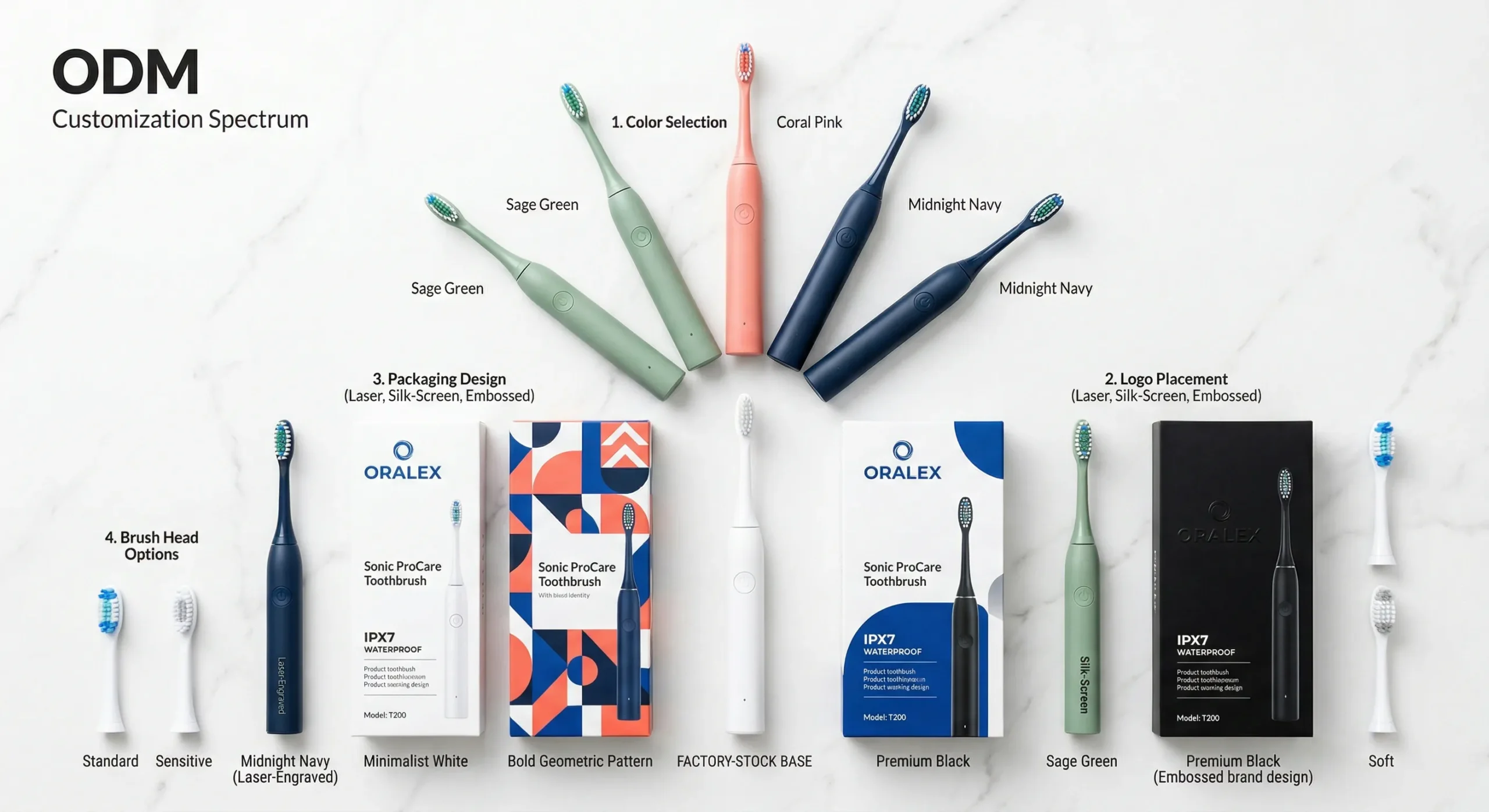
Visual Customization
- Handle colors: Pantone-matched colors from 1,000+ options
- Logo placement: Laser engraving, pad printing, IMD (in-mold decoration)
- Verpakking: Custom boxes, inserts, instruction manual design
Functional Customization
- Mode selection: Choose which electric toothbrush features (modes) to include from 1–8 options
- Default settings: Pre-configure sensitivity level, timer preferences
- App interface: Custom-branded app with your colors and logo
Feature Packaging
- Reisetui: Included or optional, standard or premium
- Replacement heads: Number included in starter kit
- Accessories: Tongue scraper attachments, UV sanitizers
Cost reality: OEM customization of kenmerken van elektrische tandenborstels typically adds 5–20% to unit manufacturing cost but enables 20–40% price premium through brand differentiation. OEM brands typically recover the feature customization cost within 6–12 months through reduced warranty returns and improved review scores.
De kenmerken van elektrische tandenborstels selected in this section—table stakes, value adders, and premium differentiators—form the foundation of your OEM product line's feature architecture.
Feature Prioritization: How OEM Buyers Select the Right Electric Toothbrush Features for Each Tier
When building your product specification for kenmerken van elektrische tandenborstels, use this tiered framework:
Table Stakes (Include on All Models)
- Minimum 2 brushing modes (clean + sensitive)
- 2-minute timer with quadpacer
- Pressure feedback (visual or vibration)
- IPX7 water resistance
- At least 14-day battery life
Value Adders (Include on Mid-Range)
- 4+ brushing modes
- 3+ week battery life
- Multiple color options
- USB charging option
- Multiple brush head types included
Premium Differentiators (Selective Inclusion)
- Bluetooth-verbinding
- AI coaching features
- Fast charging (2–4 hours)
- Premium travel case
- Custom app integration
Avoid (Unless Specifically Required)
- Unproven health claims (e.g., "kills 99.9% of bacteria")
- Excessive mode counts without clear user benefit
- Features that add cost but can't be explained in one sentence
Need Help Prioritizing Your Electric Toothbrush Features?
Every feature decision affects your BOM, MOQ, and lead time. Our OEM team can walk you through the trade-offs for your specific target price point and market positioning.
OEM Electric Toothbrush Features: Sourcing Essentials
When sourcing kenmerken van elektrische tandenborstels from a contract manufacturer, these procurement parameters matter most:
- MOQ (minimale bestelhoeveelheid): Standard configurations: 500–1,000 units per SKU. Custom feature combinations or non-standard brush head molds: 1,000–2,000 units. Mixed configurations across your product line can reduce per-unit cost.
- Doorlooptijd: Standard OEM production: 45-90 dagen from sample approval. Custom PCB programming or proprietary motor specs: 60-120 dagen. Battery certification testing adds 2–4 weeks if UN38.3 compliance is required for your target market.
- Quality Control (QC): Relish Technology performs IQ/OQ/PQ-validatie on all production batches. Pre-shipment inspection includes waterproof testing (IPX7 pressure hold), battery cycle testing, and mode function verification. AQL standard: 0.65 for critical defects, 1.5 for major defects.
- Certificeringen: Our Shenzhen facility holds FDA 21 CFR Part 820, CE MDR compliance, ISO 13485:2016 certification. All electric toothbrush products carry FCC EMC certification. Market-specific certifications (CCC for China, PSE for Japan, KC for Korea) available on request.
Making the Final Decision
When prioritizing kenmerken van elektrische tandenborstels, Feature selection ultimately comes down to three questions:
1. Who is your target customer?
Tech-forward millennials want smart features and app integration. Value-conscious families want reliability and price. Premium seekers want silence and performance. Your customer profile drives feature prioritization.
2. What price point are you targeting?
Each functie van een elektrische tandenborstel adds cost. Map features to price tiers and ensure each tier is independently profitable:
- Entry ($25–40): Table stakes + one differentiator
- Mid ($40–70): Table stakes + 2–3 value adders
- Premium ($70+): All features including smart technology
3. What can you support?
Slim kenmerken van elektrische tandenborstels require ongoing app maintenance. Complex products need better user manuals. Multiple SKUs require inventory management. Be realistic about operational capacity.
Ready to Specify Your Electric Toothbrush?
Understanding features is the first step. Implementing them across a cohesive product line is where the real work begins.
FAQ: Electric Toothbrush Features for OEM Buyers
Selecting kenmerken van elektrische tandenborstels for an OEM product line involves dozens of technical and commercial trade-offs. These are the most common questions our team hears from buyers evaluating their first order or expanding an existing lineup across premium, mid-market, and entry-level kenmerken van elektrische tandenborstels.
Q: How many brushing modes should an electric toothbrush have?
Voor de meeste OEM-merken volstaan 3–4 standen (normaal, gevoelig, witmaken/tandvleesverzorging) om 90% aan consumentenbehoeften te dekken zonder onnodige kosten. Vermijd een overdaad aan functies: standen die consumenten niet begrijpen of niet gebruiken, leiden eerder tot marketingruis dan dat ze toegevoegde waarde bieden.
Q: Are pressure sensors worth the manufacturing cost?
Ja. Druksensoren brengen, afhankelijk van het type, $0.50–$3.00 per eenheid extra kosten met zich mee, maar zorgen voor minder garantieclaims, retourzendingen en klachten van klanten. Het rendement op de investering is doorgaans al binnen het eerste verkoopjaar positief, met name voor merken die via e-commercekanalen verkopen.
Q: What battery life do consumers expect from electric toothbrushes?
Consumenten verwachten tegenwoordig dat premium- en middenklasseproducten meer dan 3 weken meegaan op één oplaadbeurt. Bij budgetproducten wordt doorgaans uitgegaan van een gebruiksduur van meer dan 2 weken. Lithium-ionbatterijen hebben Ni-MH vervangen als standaard voor alle producten met een adviesprijs van meer dan $30.
Q: Should I include Bluetooth/smart features in my electric toothbrush?
Neem Bluetooth alleen op als: uw merk zich richt op technologisch onderlegde consumenten, u zich positioneert in de prijsklasse $80+ (adviesprijs), en u budget heeft voor doorlopende app-ontwikkeling. Voor budget- en middenklasseproducten kunt u de connectiviteit beter achterwege laten — de extra kosten staan niet in verhouding tot de verwachtingen van de consument in die prijsklassen.
Q: How do I decide which features to include in different price tiers?
Gebruik een gelaagde aanpak: alle modellen krijgen basisfuncties (timer, quadpacer, drukfeedback, IPX7). Het middensegment voegt batterijduur en extra modi toe. Premium omvat slimme functies en premium accessoires. Elke laag moet onafhankelijk winstgevend zijn tegen de beoogde verkoopprijs.
Q: What IP rating should I require for my electric toothbrush?
IPX7 (1 meter onderdompeling gedurende 30 minuten) zou uw minimale standaard moeten zijn. Claims van waterdichtheid zonder specifieke IP-classificatie zijn rode vlaggen. Hogere classificaties (IPX8) verhogen de kosten met afnemend consumentenvoordeel, tenzij u specifiek voor douchegebruik op de markt brengt.
Q: Can I customize which features are included in my OEM product?
Ja. Onze faciliteit in Shenzhen biedt modulaire functieconfiguratie voor de meeste productlijnen. U kunt het aantal modi, batterijtype, druksensorstijl, oplaadmethode en accessoires onafhankelijk specificeren. Minimale bestelhoeveelheden zijn van toepassing voor niet-standaard configuraties.
Q: What customization options are available for OEM branding?
Naast functies bieden we handgreepkleurafstemming (Pantone), logotoepassing (laser, tampondruk, IMD), aangepast verpakkingsontwerp en app-interface branding voor verbonden producten. Maatwerk voegt doorgaans 5–20% toe aan de eenheidskosten, afhankelijk van de omvang.
Referenties
- American Dental Association. (2024). Toothbrushes. ADA Science & Research Institute. Retrieved from https://www.ada.org/resources/ada-library/oral-health-topics/toothbrushes
- International Electrotechnical Commission. (2024). IP Ratings Explained. IEC. Retrieved from https://www.iec.ch/ip-ratings
- Relish Technology. (2025). Electric Toothbrush OEM Manufacturing Capabilities. Shenzhen: Relish Technology. (Removed — internal document, not publicly citable)
- Grand View Research. (2025). Electric Toothbrush Market Size, Share & Trends Analysis Report. Ontleend aan https://www.grandviewresearch.com/industry-analysis/electric-toothbrush-market
- Statista. (2025). Oral Care Products - Worldwide. Ontleend aan https://www.statista.com/outlook/cmo/oral-care/worldwide